
Flare CEO XRP Utility: Why Holders Should Build Beyond Ripple
Flare CEO Hugo Philion urged XRP holders to build practical use cases for the token beyond Ripple, aiming to transform the asset from speculative trading into functional capital using the Flare network.

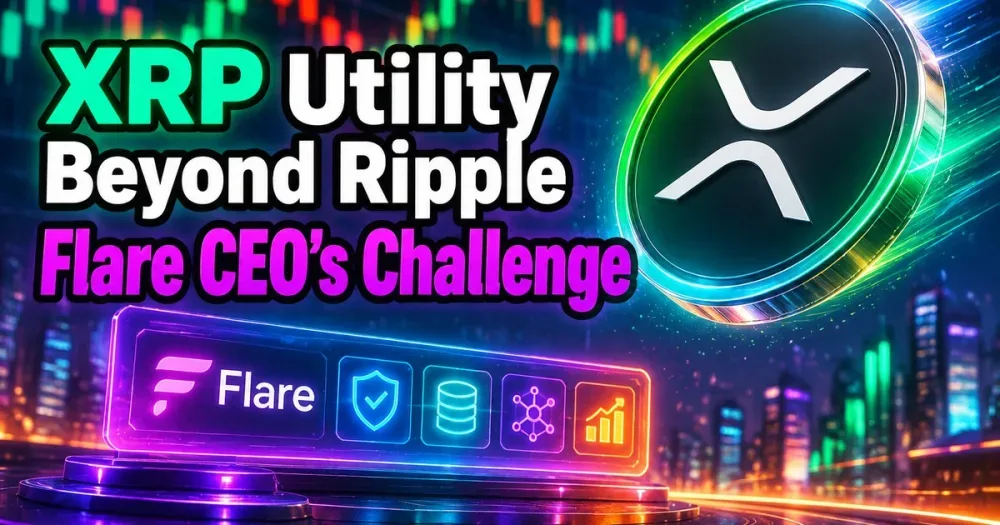
Flare CEO Hugo Philion urged XRP holders on Nov. 8 to prioritize building practical use cases for the token rather than measuring its future primarily through Ripple. Trading at $1.16 at the time, Philion’s push for XRP utility centers on moving the asset away from heavy speculation and transforming it into functional, usable capital.
Philion’s statements arrive amid a challenging period for XRP. According to U.Today, the token dropped roughly 50% over the preceding year, while data from CoinGecko recorded a 0.47% decrease in the 24 hours leading up to Nov. 8.
Philion’s XRP Utility Challenge Starts With Holders
Three questions behind the appeal
Philion challenged XRP holders to evaluate their current actions regarding their tokens, determine how to attract new investors, and consider ways the community can transition the asset from a speculative instrument to usable capital. This line of questioning shifts the focus away from Ripple’s potential actions and onto the capacity of holders and developers to generate demand organically.
His argument does not dismiss Ripple’s historical importance to XRP. Instead, he maintained that the token’s narrative and value ought not to rely on a single entity. Philion emphasized that holders should assume greater responsibility in forging practical applications.
Why Flare is part of his pitch
As a potential solution, Philion encouraged XRP holders to explore Flare, presenting the network as a method to reduce the token’s reliance on Ripple. He noted that Flare was established precisely because there is untapped potential in what can be done with XRP.
This serves as a conceptual proposal rather than definitive proof that XRP has already decoupled from Ripple or that Flare has measurably altered the token’s market performance. This distinction is critical: Philion is outlining a vision for where development might take place, while holders must evaluate whether the ecosystem suits their needs.
Who Is Hugo Philion and What Does Flare Do?
Philion’s role in the argument
As the CEO of Flare, Philion combines broader perspectives on the future of XRP with a direct invitation to engage with Flare, ensuring he has a vested interest in the ecosystem he advocates.
He reiterated that XRP holders should look past Ripple’s corporate decisions and focus on building practical utility. His proposed trajectory envisions XRP operating as active capital instead of an asset defined primarily by speculative trading.
FXRP and the role of FLR
FXRP functions as a tokenized representation of XRP on the Flare network. In response to an X user who suggested that users could interact with Flare’s decentralized finance ecosystem using FXRP without holding FLR, Philion disagreed.
He explained that while Flare Smart Accounts minimize the visible friction of managing FLR, they do not eliminate the token’s foundational function: FLR is still required to cover transaction fees on the underlying networks. In essence, a streamlined user experience can abstract fee management without dispensing with the fees themselves or the token utilized to settle them.
Why Ripple’s Role Became a Flashpoint for XRP Holders
Frustration over performance
Philion’s commentary coincided with widespread frustration regarding XRP’s market performance and a prevailing habit within the community of tying the token’s worth strictly to Ripple’s actions. While the market environment adds urgency to his points, it does not guarantee that driving utility will automatically reverse XRP’s price trajectory.
U.Today also highlighted recent criticisms aimed at Ripple’s former chief technology officer, David Schwartz, regarding XRP’s market valuation. Schwartz countered that his personal impact on the price of XRP remains heavily restricted, illustrating that high-profile figures do not necessarily wield direct control over market valuations.
Philion’s call to action places accountability directly on the XRP community, urging holders to utilize the asset and actively draw in new participants. This approach marks a departure from waiting for corporate announcements to dictate the market narrative.
At the same time, this initiative introduces a practical hurdle: determining whether applications centered around XRP can successfully foster long-term engagement. Promoting utility outlines a conceptual direction, but it does not quantify the actual volume of XRP currently utilized via Flare.
How XRP and FLR Fit Together on Flare
Smart Accounts and fee abstraction
Philion’s breakdown differentiates user interface convenience from the underlying mechanics of network fees. Through Flare Smart Accounts, users can avoid directly managing FLR, resulting in a more streamlined operational experience.
However, abstraction is distinct from eradication. Philion stressed that FLR remains integral for paying transaction fees across the underlying networks. This distinction is vital: end-users might not need to manually navigate every fee payment step, but the token itself stays active within the transactional framework.
Beyond transaction fees
Looking ahead, Philion anticipates that FLR will secure additional utility beyond covering transaction fees, noting that the broader ecosystem requires diverse sources of fee generation.
These objectives highlight two distinct inquiries: whether Flare can successfully host heightened activity involving XRP, and whether that activity will unlock wider fee structures and use cases for FLR. Because Philion did not provide a definitive timeline or scheduled launch date, his statements outline an overarching ambition rather than an imminent protocol upgrade.
XRP Price Context: $1.16 and Technical Levels
Market figures as of Nov. 8
Data from CoinGecko positioned XRP at $1.16, accompanied by a market capitalization hovering near $73.52 billion and a 24-hour trading volume of approximately $878.42 million. The token experienced a minor 24-hour drop of 0.47%.
This market environment exists independently of Philion’s commentary on utility. His remarks did not introduce a new product launch or immediate market catalyst, and current price metrics do not measure adoption rates on Flare.
Support and resistance areas cited by CryptoPotato
Technical assessments from CryptoPotato pointed to a nearby demand zone at $1.09–$1.14 following a breakdown below the $1.24–$1.28 bracket, with the $1.15 low acting as an immediate downside threshold.
In the event of a market rebound, the analysis cited $1.18–$1.20 as the initial hurdle to clear, followed by the $1.24–$1.28 region and a higher supply ceiling stretching from $1.30 to $1.34. These charted boundaries represent technical observations rather than guaranteed market paths, offering background context for traders monitoring whether XRP will consolidate or extend its losses.
What Could Strengthen or Weaken the Utility Case?
The constructive case
The core of Philion’s positive thesis is that developers and token holders can generate organic utility for XRP through practical engagement that extends past speculative trading. Flare is framed as a designated venue for this effort, utilizing FXRP to bring a tokenized derivative of XRP into its decentralized network.
For this argument to gain traction, the ecosystem must cultivate meaningful adoption and robust fee-generating mechanisms—outcomes that Philion explicitly advocated. Because current reports do not quantify active XRP utilization or fee yields on Flare, the proposition remains centered on future development goals.
How the Binance Theft Added Pressure to XRP’s Market Context
About $50 million moved into bitcoin
In parallel, security incidents brought significant portions of the XRP supply under intense scrutiny. Bitcoin Magazine reported that hackers linked to a breach at Binance converted approximately 42 million stolen XRP—valued at roughly $50 million—primarily into bitcoin via THORChain. These swaps pushed the total amount of bitcoin recovered from various stolen digital assets to roughly 1,650 BTC, valued at approximately $124 million based on prevailing rates.
At the time of the update, approximately 192 million XRP, equating to roughly $226 million, remained in wallets associated with the breach. While these statistics reflect assets tied to a criminal exploit rather than routine liquidations by retail holders, the potential future circulation of these balances presents a distinct supply-side concern separate from Flare’s utility discussions.
The earlier transfers and what comes next
The stolen XRP originated from an October 29 security breach, during which five hot wallets transferred 233.46 million XRP to an attacker-controlled address between 20:05 and 20:09 UTC. The FBI subsequently attributed the cyber campaign to North Korea’s TraderTraitor collective. Binance later evaluated the aggregate theft at $6.34 billion, progressively restoring withdrawal capabilities, freezing or capturing about $2.85 billion, and pledging to reimburse affected users using corporate reserves.
According to blockchain analytics firm Elliptic, the stolen XRP remained dormant initially. Between 02:12 and 04:00 UTC on November 2, roughly 233 million XRP was funneled into six newly created addresses, where it sat until November 5. Starting on the afternoon of November 5, two of those wallets began dispersing XRP to numerous newly generated accounts for conversion, predominantly routing the funds through THORChain into bitcoin.
The illicit fund movements extended beyond XRP. Over 20,000 wallets spread across 16 different blockchains, encompassing at least 65,000 separate transactions, were flagged as part of the laundering pipeline. Meanwhile, approximately $3.11 billion remained locked in hacker-associated addresses, predominantly held in ether and bitcoin. With the primary holdings of bitcoin and ether still static in the latest updates, market observers are watching to see if the remaining XRP and parked cryptocurrency assets will follow a similar conversion path into bitcoin.
Unlike certain stablecoins that issuers can readily freeze, assets like XRP and bitcoin cannot be frozen through centralized administrative controls. This dynamic helps account for why the attacker prioritized these cryptocurrencies after large tranches of stablecoins were locked down on October 29. Cross-chain operators and decentralized bridges like THORChain will face ongoing scrutiny regarding their ability to flag and halt transactions involving identified attacker addresses quickly enough to hinder further XRP-to-bitcoin laundering operations.
What Happens Next for XRP and Flare?
Building activity is the next test
Because Philion omitted specific deadlines or scheduled deployment dates, the immediate test relies on whether developers and holders answer the call to expand XRP utility and generate transaction activity within Flare’s network.
Consequently, the near-term narrative hinges on execution rather than a fixed calendar milestone. Any prospective use case must evolve from a conceptual goal into heavily utilized infrastructure before supporting any definitive claim that XRP has achieved broader utility.
What holders can watch
For XRP participants, critical indicators include actual transaction metrics surrounding FXRP, the operational function of FLR in settling network operations, and whether Flare’s ecosystem scales past basic fee settlement. These represent the core focus areas outlined by Philion, who avoided establishing explicit price targets for either XRP or FLR.
On the trading front, market participants continue to monitor whether XRP can successfully defend the support levels outlined by CryptoPotato or stage a recovery past established overhead resistance thresholds. Price performance and underlying ecosystem progress remain entirely separate variables, and neither should be interpreted as a guarantee of the other.
FAQ
What did Flare CEO Hugo Philion say XRP holders should focus on?
Philion urged holders to find ways to use their XRP, encourage potential investors to hold it, and help shift the asset from speculation toward usable capital. He pointed to Flare as one possible place to pursue that goal.
Why does Philion want XRP to be less dependent on Ripple?
He argued that XRP’s value and narrative should not hinge on the actions of a single actor. His view is that broader community use could give the asset a wider basis than Ripple’s decisions alone.
What is FXRP on Flare?
FXRP is a tokenized version of XRP on Flare. Philion referred to it when discussing how XRP holders can use Flare’s decentralized finance ecosystem.
Why does FLR still matter when Flare Smart Accounts simplify fees?
Philion said Smart Accounts abstract away the need to manage FLR directly, but FLR is still used to pay transaction fees on the underlying networks. The account experience can be simpler without removing the fee token’s role.
What was XRP’s price when Philion made his comments?
XRP traded at $1.16 in the coverage published Nov. 8. CoinGecko’s 24-hour figure was a 0.47% decline.
Did Philion announce a date for new Flare use cases?
No dated launch or deadline accompanied his comments. He called for broader use cases and fee generation over time, without naming a specific milestone.
Which XRP price levels are traders watching?
CryptoPotato’s analysis cited $1.09–$1.14 as a nearby demand zone and $1.24–$1.28 as a former support area that could act as resistance. It also identified $1.30–$1.34 as a higher supply zone.

Web3 PR Specialist | KOL | Blockchain Advocate | Digital Strategy Expert based in Moscow, Russia. Focused on Web3 communications, blockchain, digital strategy, and community growth.
More from this author
Comments 0 responses