
GPT-6.2 Astra: Same Intelligence as Gemini 4 Carbon, 73% Lower Cost
OpenAI launched GPT-6.2 Astra, matching Google Gemini 4 Carbon in intelligence while delivering equivalent professional and scientific workloads at a 73% lower cost and five times faster speed.

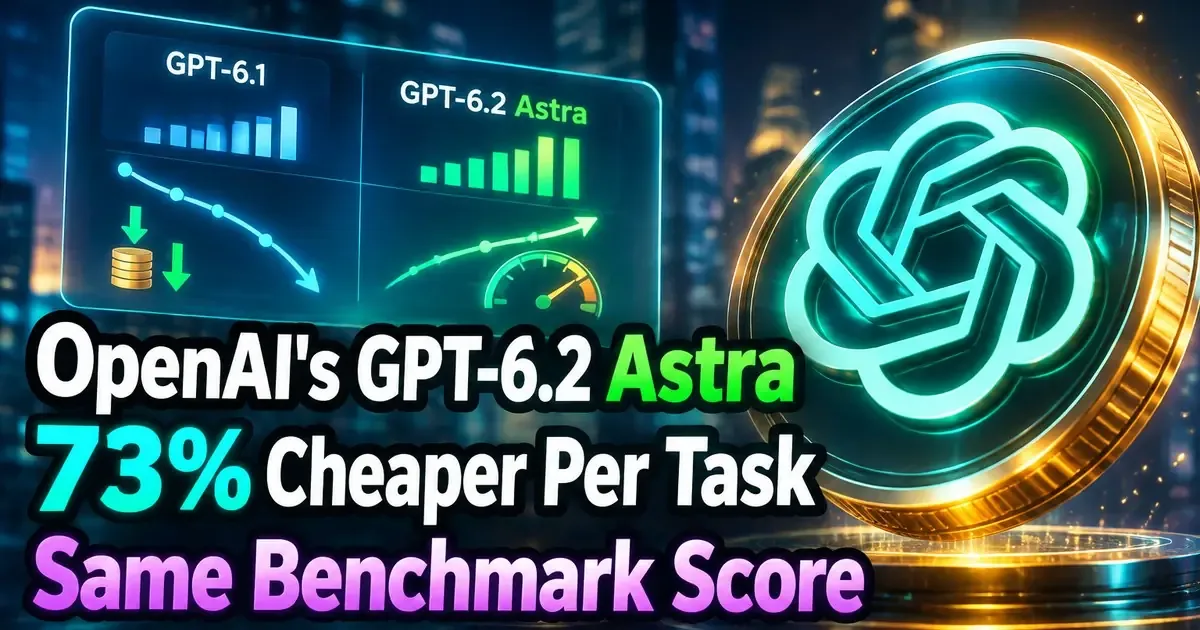
OpenAI launched GPT-6.2 Astra on November 17, 2026, positioning it as an advanced AI tool tailored for demanding professional, scientific, and technical workloads. It ties with Google’s Gemini 4 Carbon on the Artificial Analysis Intelligence Index—both achieving a score of 60 at high effort—yet executes equivalent jobs 73% more affordably and five times faster. This divergence highlights a fundamental shift in AI cost-effectiveness, moving away from per-token expenses toward the cost of a completed job.
Simultaneously, the company rolled out GPT-6.2 Sol, a more lightweight option designed for everyday responsibilities. This release strategy effectively separates heavy frontier capabilities from routine operational efficiency. Complex workloads are routed to the heavyweight option, while standard tasks utilize the streamlined alternative. Furthermore, both options generate fewer output tokens for the same level of quality, easing constraints on usage caps.
What Happened: GPT-6.2 Astra Release
OpenAI officially introduced GPT-6.2 Astra and Sol on November 17, 2026. Astra focuses on professional and scientific applications, whereas Sol handles routine assignments with performance superior to its predecessor.
API pricing was reduced for both offerings. Input and output expenses decreased by 20% compared to GPT-6 Astra, and cached input rates fell by 60%. Meanwhile, GPT-6.2 Sol maintains its current API pricing while delivering enhanced performance.
The speed differential is most apparent in response times. Operating at high effort, Astra delivers its initial token in 20.30 seconds, compared to 69.13 seconds for Carbon—making it more than three times quicker. While Astra sustains a rate of 46–49 tokens per second against Carbon’s 61, total task duration reveals the actual advantage: Astra wraps up high-effort assignments in 6.5 minutes, whereas Carbon requires 33.3 minutes.
Contra Labs reviewed Astra on design benchmarks, noting a 73% win rate in blind evaluations alongside top-tier design critique scores on the Frontier Design Benchmark. Professional designers judged the outputs derived from authentic client briefs using a structured rubric.
Independent performance and cost assessments were conducted by tracking entities such as Artificial Analysis and DataCamp. DataCamp tested both models via OpenCode using identical prompts at medium effort: two successful attempts by Carbon cost $1.09 and $0.83 each, while three successful Astra attempts ranged from $0.36 to $0.43 each. Although Carbon’s per-token pricing was a quarter of Astra’s, its total task expense was two to three times greater. Additionally, CodeRabbit assessed Astra’s coding output through actual pull request workflows.
Background: The Astra Lineage
The frontier AI landscape is currently led by three major systems: OpenAI’s Astra, Anthropic’s Claude Fable 5.2, and Google’s Gemini 4 Carbon. Introductory pricing for Carbon is set to expire on December 1, 2026, shifting rates from $2/$10 to $4/$20 per million tokens for input and output.
OpenAI highlights industries like manufacturing, automotive, and architecture as immediate beneficiaries of Astra’s 3D simulation and tool-integration features. Additionally, its scientific capabilities—highlighted by a 75.2% score on Terminal-Bench-Science—target researchers working in biology, chemistry, and physics-based modeling.
Why It Matters
For Users and Businesses
Optimizing for overall task efficiency—driving down the price per finished assignment rather than per token—makes scaling complex, multi-step professional operations financially viable. Astra supports a maximum output of 128,000 tokens, accommodating longer documents and files than rival systems. By comparison, Carbon caps out at 65,536 tokens, which can occasionally truncate lengthy tasks mid-process.
For the Market
This balance of pricing and performance introduces a central industry question: will upcoming AI development prioritize token efficiency or task efficiency? These represent entirely different targets. A model that yields a higher volume of tokens yet solves a problem more economically on a per-job basis outperforms an alternative that produces fewer tokens but takes significantly longer to complete. Carbon functions as a reasoning model that “thinks in prose,” billing the user for every word generated during the reasoning phase. At high effort, it spends five times as long on an assignment as Astra does under identical settings, with costs scaling directly alongside that time. Astra finalizes high-effort jobs in 6.5 minutes compared to Carbon’s 33.3 minutes, despite achieving identical benchmark scores.
For the Industry
Astra’s competence in scientific research, 3D simulation, and direct tool utilization (including CAD, Blender, and code execution) marks a broader industry transition from basic text generation toward engineering and design workflows. Such tasks demand structured reasoning chains and tangible artifact creation rather than simply fluent prose.
The Numbers: Benchmarks, Costs, and Trade-Offs
Intelligence and Performance
On the Artificial Analysis Intelligence Index, Astra scores 60 at high effort and 62 at maximum effort, tying with Gemini 4 Carbon’s score of 60 at high effort. For scientific evaluations on Terminal-Bench-Science, Astra achieves 75.2%, outpacing both Carbon (64.8%) and Claude (64.8%). On the FrontierCode-AA 2.0 coding benchmark, Astra reaches 47.1%, while Carbon and Claude each score 40.6%.
Cost per Task
At high effort, Astra incurs a cost of $2.07 per finished task, whereas Gemini 4 Carbon reaches $7.76. At maximum effort, Astra runs to $4.00. The underlying mechanic is straightforward: Carbon operates as a reasoning model that “thinks in prose,” charging for every generated word. When operating at high effort, Carbon generates five times the volume of tokens as Astra to arrive at the same score. Side-by-side evaluations conducted by DataCamp showed successful Carbon runs costing $1.09 and $0.83 each, contrasted with Astra runs ranging from $0.36 to $0.43.
Per-Token Pricing vs Per-Task Reality
Base token rates for Astra are structured at $8 for input and $40 for output per million tokens. Carbon’s current rates sit at $2 for input and $10 for output through the end of November, increasing to $4 and $20 respectively after December 1. Based purely on raw token cost, Carbon is cheaper initially and will remain half the price of Astra following the December adjustment. However, the disparity in token volume completely shifts the final bill. Because Carbon’s high-reasoning mode generates substantially more text, its overall cost per job remains higher despite the lower individual token rate.
Output Token Limits and Task Completion
A structural distinction exists between Astra’s 128,000-token output limit and Carbon’s 65,536-token ceiling, a boundary illustrated during DataCamp’s testing. During a high-effort run, one Carbon attempt consumed 40,881 tokens purely on reasoning before hitting the 65,536-token single-response ceiling while still drafting the final output file, resulting in complete data loss. A separate attempt experienced a provider disconnection and timed out after 18 minutes. Across varying effort tiers, five attempts yielded just two functioning pages from Carbon, whereas Astra successfully produced six working pages from six separate attempts, completing each within six to seven minutes at high effort and under three minutes at medium effort.
This limitation represents a structural vulnerability rather than a random error. An agent that processes forty thousand reasoning tokens prior to drafting text leaves itself with roughly twenty-five thousand tokens to construct the final artifact. Requesting extended files, full code migrations, or single-pass documentation causes the system to reach its ceiling mid-task rather than upon completion. Astra’s higher threshold avoids this premature cutoff during prolonged operations.
3D and Design Capabilities
Astra achieved an Elo rating of 1,318 on AA-3D, an independent evaluation framework for three-dimensional tasks, securing the benchmark’s top spot. Claude Fable 5.2 followed in second place with 1,271 Elo. OpenAI showcased an end-to-end engineering pipeline wherein Astra transformed a rough hand-drawn sketch into CAD parts, generated a Python motion dynamics solver, and produced a Blender scene file accompanied by instructions. The system accepts multimodal inputs combining images and text, executes code, and interfaces with external software to daisy-chain capabilities into multi-step pipelines. Rather than replacing CAD and 3D utilities, Astra functions as an advanced power user interface for engineering and design tasks. Initial disclosures did not reference physical 3D printing or empirical real-world validation of the generated designs.
Risks and Open Questions
Internal evaluations by OpenAI revealed that GPT-6.2 Astra overlooks coding blockers roughly twice as frequently as GPT-6 Astra, indicating a regression across certain quality metrics. Similarly, CodeRabbit’s trials indicated that Astra successfully identified 58 out of 83 known issues during pull request workflows, compared to a baseline of 54. While Astra flagged 11 known issues missed by the baseline and missed seven that the baseline caught—representing a net gain of four—its high-reasoning run generated 589 distinct actionable comments versus the baseline’s 253, more than doubling the volume. Of those 589 remarks, only 72 corresponded to genuine known issues, leaving 517 requiring human filtration and raising questions regarding the signal-to-noise ratio.
Astra generates a higher volume of tokens than anticipated relative to its output quality, which partially offsets its advantages in per-task economy. Although task efficiency is evident, token efficiency remains an area where Astra does not excel.
Furthermore, the reported 73% design preference win rate stems from professional designer evaluations rather than an automated benchmark, meaning replicability and broader cross-domain generalization remain uncertain. Competitive updates from Google and Anthropic targeting specialized workloads have also not yet been evaluated post-launch.
What Happens Next
December 1 marks a significant pricing milestone with the expiration of Google Gemini 4 Carbon’s introductory rates. Token expenses will transition from $2/$10 to $4/$20 per million input and output tokens, which will compress the per-token gap while further widening the per-task cost disparity in Astra’s favor. Once these December adjustments take effect, Carbon’s input pricing will reach double Astra’s current $8 rate, while its output pricing will align with Astra’s $40 rate. Given that Carbon generates five times the token volume during high-effort execution, the gap in per-task expenses is projected to expand from 3.7× to roughly 4–5× depending on the specific workload.
In addition, OpenAI’s cached input discount—offering 60% savings on input costs—encourages users to store extensive system prompts and reference materials, driving overall economics further toward task-based efficiency. Meanwhile, Sol 6.2 maintains its current pricing structure, positioning it as the default choice for everyday enterprise and consumer tasks.
FAQ
When did OpenAI release GPT-6.2 Astra, and when will GPT-6 Astra be retired?
OpenAI released GPT-6.2 Astra and Sol on November 17, 2026. No end-of-life date has been announced for GPT-6 Astra.
What is the actual difference between GPT-6.2 Astra and GPT-6.2 Sol?
Astra is the frontier model for complex professional, scientific, and design work. Sol is the lighter, everyday model aimed at routine tasks. Sol is cheaper and faster but less capable on hard problems. OpenAI’s framing suggests Sol will become the default for most daily usage.
How does multimodal input and tool use work in Astra?
Both Astra and Sol accept text and images. A user can submit a sketch instead of describing it in prose. Both models can run code and control external software (CAD programs, Blender, code editors), enabling multistep simulation pipelines. Astra does not replace these tools—it augments them, acting as a power user interface.
Which sectors will see the most benefit from Astra’s 3D and scientific strengths?
OpenAI points to manufacturing, automotive, and architecture as sectors where Astra’s 3D simulation and tool-use capabilities will have immediate effect. Its scientific strengths (Terminal-Bench-Science score of 75.2%) target researchers in biology, chemistry, and physics-based modeling.
How will Carbon’s December 1 pricing change affect the cost gap between Astra and Carbon?
When Carbon’s introductory pricing expires on December 1, its per-token rate moves from $2/$10 to $4/$20 input/output per million tokens. This narrows the per-token gap but widens the per-task gap in Astra’s favor because Carbon still generates more tokens for the same quality. Carbon’s input rate will then be 2× Astra’s current $8 rate; its output rate will reach Astra’s $40 rate. Since Carbon produces 5× the tokens at high effort, the per-task cost gap will deepen from 3.7× to roughly 4–5×, depending on the task.
Is there real-world evidence that Astra can produce usable 3D designs and CAD files?
OpenAI demonstrated Astra converting sketches to CAD parts, motion solvers, and Blender scenes in controlled tests. Initial reports did not mention physical 3D printing or on-site manufacturing testing, only computational simulation. Production results will emerge as users deploy the model.
How does Astra’s coding performance compare in real production codebases?
CodeRabbit’s testing on 83 known issues found Astra caught 58 issues versus a baseline of 54, a net gain of four. However, Astra’s high-reasoning run produced 589 comments versus the baseline’s 253—a 2.3× increase in volume. While coverage improved, most additional comments require manual review to separate useful findings from noise, adding friction to the review process. Only 72 of the 589 comments matched known issues; the remaining 517 need human filtering.

Web3 PR Specialist | KOL | Blockchain Advocate | Digital Strategy Expert based in Moscow, Russia. Focused on Web3 communications, blockchain, digital strategy, and community growth.
More from this author

Comments 0 responses