
How to Buy Monero with a Debit Card Without Verification
Learn how to buy Monero using a debit card without creating an account by placing guest orders on platforms like ChangeNOW. Understand the differences between bypassing registration and avoiding verification.

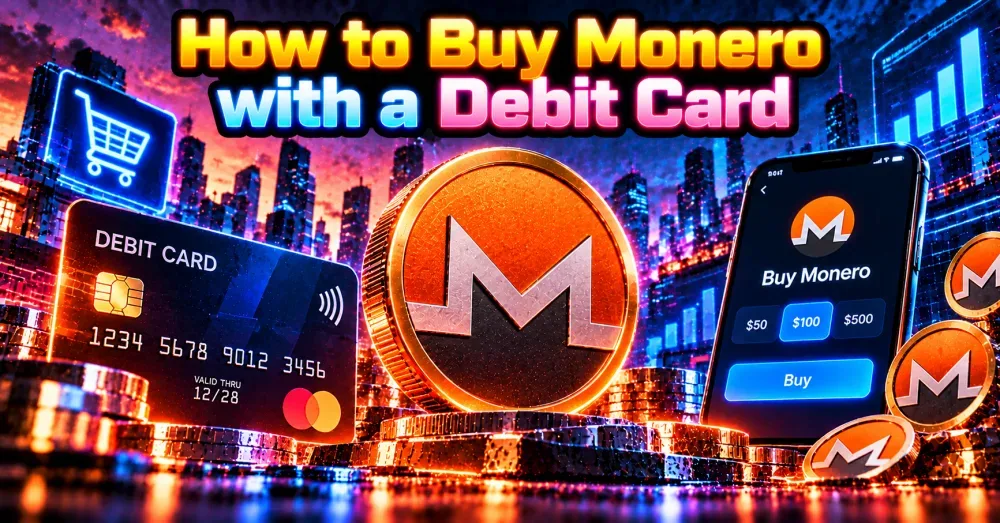
ChangeNOW is a choice for purchasing Monero with a debit card without needing an account. You place a guest order, complete the payment using Visa, Mastercard, Apple Pay, or Google Pay via its fiat providers, and single transactions can range anywhere from $20 to $20,000.
Bypassing the account requirement does not eliminate verification. Your bank may request payment confirmation, and the card processor can ask for identification, most commonly during a first-time order or for larger transactions.
Purchasing crypto with a card generally incurs a higher cost than swapping digital assets you already own, as card processing fees are integrated into the quoted price. To evaluate different platforms, examine the exact amount of XMR each service estimates you will receive.
You can buy Monero using a debit card without opening an account, as several platforms facilitate this exact workflow. What you cannot expect is a purchase entirely devoid of verification. The financial institution backing your card may require you to authorize the transaction, and the underlying payment processor holds the right to verify your identity, particularly on an initial purchase or for higher sums.
If your goal is to buy XMR with a debit card without providing an ID, this distinction is far more significant than your choice of platform. A one-time bank authentication code, an identification request from a payment vendor, and an anti-money laundering review represent three distinct evaluations conducted by separate entities under their own regulations.
Key facts
| Factor | Detail | Source |
| Card purchases on ChangeNOW | $20 to $20,000 per single purchase; Visa, Mastercard, Apple Pay, Google Pay, SEPA and SWIFT through fiat providers; 40+ fiat currencies | ChangeNOW |
| Card authentication | 3-D Secure may ask for a one-time code, a banking-app approval or biometrics | Visa |
| AML scope | Businesses that sell crypto for fiat count as virtual asset service providers | FATF |
| Threshold for lighter checks | Occasional transactions under USD/EUR 1,000 | FATF |
| What KYC usually involves | Identity verification, most often with a photo ID such as a passport | CoinMarketCap Academy |
| EU rules from July 2027 | Licensed crypto providers restricted from handling anonymity-enhancing coins | EUR-Lex, Regulation (EU) 2024/1624 |
Data as of October 2026
Can You Buy XMR Without Creating an Account?
Yes. Several cryptocurrency platforms let you purchase Monero via card without establishing an account by completing the order as a guest. You select the desired amount, input a Monero destination address, and submit payment, allowing the coins to transfer directly to your wallet. No balance is retained by the platform, and no login credentials are created for future visits.
A secondary enterprise typically operates behind the order interface. Numerous crypto platforms do not handle card transactions directly; instead, a licensed fiat partner accepts the payment, executes the conversion, and fulfills the purchase. This provider operates under its own policies, which govern the majority of the checkout experience.
Traditional exchange accounts function in reverse. You must register first, verify your identity, deposit funds, and make a purchase only after that balance is established. For a single transaction routed straight into a private wallet, the guest approach involves considerably fewer steps.
Can You Buy Monero Without Registration?
You can bypass standard sign-up procedures, yet card payments still necessitate specific personal details. Utilizing a card requires entering the name printed on it, the card number, and frequently a billing address. Processors commonly request an email address as well, both to deliver receipts and to reach out if order processing stalls.
This falls short of traditional registration. You do not acquire a user profile or password, and no data is stored for subsequent purchases. Nevertheless, this remains personal information, which is transmitted to the payment processor regardless of whether you hold an account elsewhere.
Consequently, labeling these purchases as entirely anonymous would be inaccurate. Your name travels alongside the card transaction regardless of how minimal the data collection is on the crypto platform itself.
If you want to prevent bank records from linking you to the transaction, using a card is unsuitable, though alternative lawful methods exist. One approach is swapping crypto you currently own: an instant conversion service can exchange assets like BTC, LTC, or a stablecoin for XMR without requiring an account or card network involvement. Another alternative is a peer-to-peer marketplace.
LocalMonero, historically the most prominent P2P platform, closed in 2024, leaving the open-source Haveno network to address part of that void. Haveno enables buyers and sellers to settle transactions via bank transfers and comparable payment methods. Cards are rarely supported on P2P marketplaces because sellers lack protection against transaction chargebacks.
When Can Compliance Checks Apply to an XMR Purchase?
Compliance reviews can be triggered by any transaction, though specific circumstances significantly elevate the likelihood. According to Financial Action Task Force (FATF) guidelines concerning virtual assets, any enterprise selling cryptocurrency in exchange for fiat currency is designated as a virtual asset service provider and must enforce anti-money laundering controls. The card processor facilitating a Monero purchase falls directly into this category.
In practical terms, investigations usually originate from the scale of the transaction. While FATF guidelines permit providers to apply reduced scrutiny to occasional transactions falling under USD/EUR 1,000, firms possess the autonomy to enforce more stringent internal caps, a practice many adopt. Data inconsistencies serve as another frequent trigger, such as a card issued in one nation, a billing address located in another, and an internet connection originating from a third location. Sanctions screening is similarly standard practice.
Fraud concerns carry significant weight as well. Stolen payment cards can be subjected to chargebacks weeks later, long after the purchased XMR has left the provider’s possession. This imbalance explains why card-based crypto purchases attract tighter oversight than many other web-based transactions, and why initial orders originating from a new card often undergo extended evaluation.
How Does an Account-Free Monero Purchase Work?
The platform processes your card payment through its fiat partner, acquires XMR on your behalf, and routes it to the address you specified. A standard order follows this sequence:
- You need a designated destination for the funds. The Monero Project offers official GUI and CLI wallets via the getmonero.org downloads page, while Cake Wallet serves as a popular mobile alternative. Generate a fresh subaddress (beginning with an 8) specifically for the transaction.
- On the purchase page, select your preferred fiat currency and transaction amount. The interface will then display an approximation of the XMR output you will receive after fees.
- Input the Monero address. Double-check both the initial and final characters against your wallet, as a single erroneous character will misdirect funds permanently.
- Provide your card information, followed by whatever authentication steps your issuing bank requires.
- If the processor requires additional verification, it will prompt you at this stage. Otherwise, the payment clears, and the XMR is disbursed to your wallet, where it remains unspendable until it clears 10 network blocks (roughly 20 minutes).
Users can execute account-free transactions, but ChangeNOW clarifies that account-free access does not equate to KYC-free access, and compliance protocols remain applicable. Most delays subsequent to payment submission occur on the card issuer’s end. Once the payment successfully clears, the XMR transfer proceeds rapidly.
The estimated XMR figure displayed on the checkout page already accounts for associated charges: the processor’s handling fee, exchange rate spreads, and the Monero network payout fee. Consequently, this final quote offers the most reliable metric for comparing different services.
If the provider requests documentation and you prefer not to comply, you can cancel the transaction. The funds are typically returned to your card, though refund timeframes vary based on the provider and your banking institution.
Does Account-Free Access Mean KYC-Free Access?
No. These concepts reference distinct criteria, and platforms that conflate them should be avoided.
Account-free status relates entirely to registration. You forgo creating a profile, and the platform retains none on your behalf. KYC, an acronym for know your customer, pertains to identity verification. As outlined by the CoinMarketCap Academy glossary, these are the identity checks performed by crypto platforms to establish customer identities, typically by demanding a photo identification document such as a passport. A regulated provider can administer this verification on a guest transaction just as easily as on a registered user.
This reality makes blanket promises of absolute, unconditional KYC-free card purchases a red flag. A licensed payment processor would find it nearly impossible to honor that claim while preserving its regulatory standing. Services making such guarantees tend to be operating without licenses, and utilizing an unregulated processor that freezes your funds leaves you with no recourse.
What Verification Requirements Can Apply to Card Purchases?
Initial verification usually originates from your own banking institution. Online card transactions commonly run through 3-D Secure protocols, marketed as Visa Secure by Visa and Identity Check by Mastercard. Depending on evaluated risk parameters, the bank may clear the transaction automatically or prompt you for secondary verification via a one-time passcode, mobile app authorization, or biometric scan. This verifies card ownership but communicates nothing about your identity to the cryptocurrency platform.
All subsequent verification requirements are dictated by the fiat provider’s internal risk parameters and your geographic jurisdiction. The following table outlines these potential layers, ordered from least to most intensive:
| Check | Who runs it | What you may be asked for |
| Card authentication | Your bank, through 3-D Secure | A one-time code, a banking-app approval or biometrics |
| Basic details | Fiat provider | Name, email, phone number and billing address |
| Identity verification | Fiat provider | A photo ID plus a selfie or short video |
| Enhanced due diligence | Fiat provider | Proof of address or of where the money came from |
| AML review | Fiat provider or crypto service | Questions about the purpose of the purchase or the receiving wallet |
Not every transaction exceeds the first two tiers, and different processors draw these operational lines at varying thresholds.
Certain card details remain mandatory regardless of transaction volume. The name associated with the card must correspond with the individual executing the payment, and third-party cards face automatic rejection. Several banking institutions block crypto-related purchases outright, and prepaid cards are frequently turned away by processors. Should a transaction fail, contact your financial institution prior to making another attempt.
How Does ChangeNOW Handle Account-Free Purchases?
ChangeNOW enables users to acquire XMR as a guest while maintaining transparency regarding the limitations of that access: orders completed without an account may still trigger compliance evaluations. Card transactions are managed via third-party fiat partners, meaning any identification requests encountered during checkout stem from those providers’ specific policies.
Published volume boundaries for individual card transactions span from $20 to $20,000, dependent upon specific provider parameters and transactional conditions. Beyond Visa and Mastercard, the platform’s partners support Apple Pay, Google Pay, along with SEPA and SWIFT bank transfers, accommodating upwards of 40 fiat currencies.
Operating since 2017, the company cites a user base exceeding 10 million customers and maintains round-the-clock customer support. Continuous support is particularly valuable for card transactions, which represent the purchase method most prone to temporary holds. Verify that card-based purchases are accessible within your country of residence before initiating a transaction, as regional availability varies by provider.
FAQ
Can I split a large purchase into small ones to avoid an ID check?
This is discouraged. Splitting a single transaction into multiple smaller payments to remain under operational limits is known as structuring, and monitoring algorithms are specifically designed to detect it. This typically results in a frozen transaction and a far more rigorous review than the one you attempted to evade.
Is buying Monero with a card more expensive than swapping crypto?
Generally, yes. Card purchases incur processing fees that fiat providers pass along to the consumer, meaning $100 worth of XMR acquired via card typically yields a lesser amount than trading $100 worth of pre-existing cryptocurrency. Swaps bypass card networks entirely, accounting for much of the cost disparity.
Will card purchases of Monero still be possible in the EU after 2027?
It is unlikely through regulated European providers. The European Union’s anti-money laundering framework is widely interpreted as prohibiting licensed entities from facilitating privacy-enhancing coins starting in July 2027, which will likely restrict card-based acquisition channels for XMR across Europe.

Web3 PR Specialist | KOL | Blockchain Advocate | Digital Strategy Expert based in Moscow, Russia. Focused on Web3 communications, blockchain, digital strategy, and community growth.
More from this author


Comments 0 responses