
XRP Market Share Trends: Why Ripple’s Token Is Losing Ground in 2026
XRP's market share has declined from 5% to 3% in October 2026, dropping to the fifth-largest cryptocurrency position as weak price action, rising circulating supply, and stablecoin competition weigh on performance.

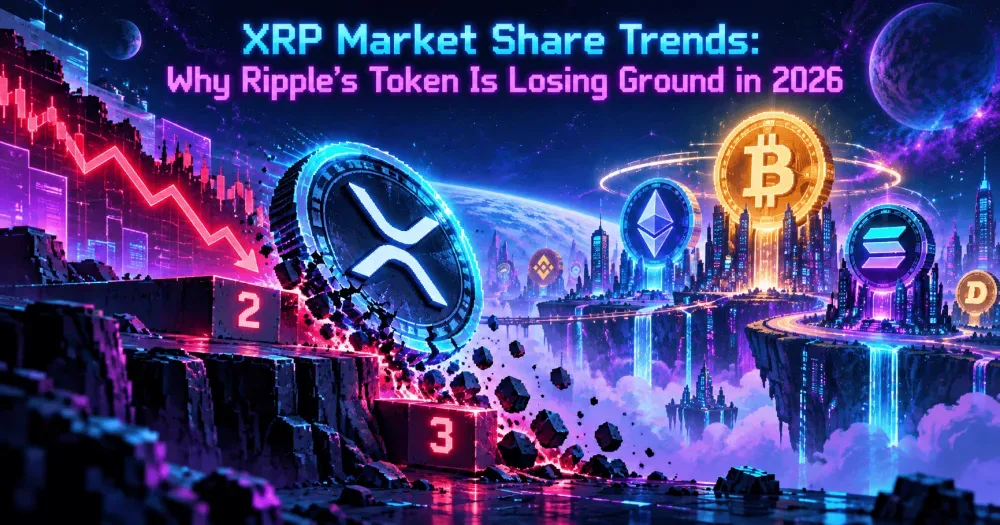
XRP’s market share has declined from approximately 5% of the total cryptocurrency market in July 2025 down to 3% by October 2026. Previously holding the position of the third-largest cryptocurrency, XRP has dropped to fifth place, trailing both Tether and BNB.
The token’s price currently sits more than 50% below the peak it reached in the summer of 2025. The central question is whether Ripple’s expanding institutional operations can successfully propel XRP into another bull market.
Related: Evernorth’s 473 Million XRP Wager Hikes as XRP Struggles to Regain Ground
XRP Market Share Changes: How Much Has It Lost?
XRP reached its peak in late July 2025, boasting a market capitalization exceeding $200 billion while the global crypto market neared the $4 trillion threshold. However, as of October 13, 2026, those gains have largely evaporated. The table below outlines the shifts in XRP’s valuation:
| Metric | July 18, 2025 | October 12, 2026 |
|---|---|---|
| XRP Price | $3.42 | $1.34 |
| Market Cap | $202.3B | $84.6B |
| Crypto Market Share | ~5% | ~3% |
| Market Cap Rank | 3 | 5 |
| Circulating Supply | 59.18B XRP | 63.13B XRP |
The contraction in XRP’s market rank and valuation becomes even more pronounced when compared against Bitcoin’s trajectory over the same timeframe. Bitcoin’s value has fallen by nearly 30% from its high, whereas XRP has suffered a 58% decline.
Why Is XRP Losing Market Share in 2026? 3 Key Factors
Several factors explain XRP’s market share loss in 2026, including weak price action, an increasing circulating supply, and the rise of alternative payment instruments. Together, these elements have weighed heavily on the token’s performance, even as regulatory and legal battles appeared to ease.
XRP Has Underperformed the Crypto Market
XRP’s strong momentum in 2025 was driven in part by anticipations of a favorable conclusion to the SEC’s lawsuit against Ripple. Yet, XRP commenced 2026 near $1.84 and has since dropped roughly 27%. Despite the underlying blockchain’s continuing appeal, XRP’s value has maintained its downward trend.
A broader crypto winter affecting most digital assets has likely contributed to this trend. Elevated U.S. Treasury yields and a robust U.S. dollar dampened appetite for cryptocurrency investments during the second half of 2026. This downward price pressure hit XRP especially hard as it navigated an increasingly crowded digital payments sector.
Ripple’s Escrow Releases Are Adding to the Supply
Substantial volumes of XRP continue to emerge from escrow accounts, with up to 1 billion XRP eligible for release each month for the foreseeable future.
The company routinely routes the vast majority of these released tokens back into escrow, leaving only a minor fraction entering general circulation. Based on an estimated re-escrow rate of 70%, about 300 million XRP remain outside escrow monthly, though these tokens are not necessarily sold or immediately integrated into the active circulating supply.
It is worth noting that large escrow releases do not automatically mean the firm has sold those tokens. Regardless, any increase in available XRP tokens places downward pressure on prices, particularly when overall token demand fails to grow.
Related: Bitcoin and Ethereum ETFs Reverse Course With $1.22 Billion in Weekly Outflows
Stablecoins Are Eating Into XRP’s Pie
XRP historically established its value because it powers one of the swiftest and most cost-effective payment networks globally. This capability was vital in facilitating frictionless value transfers and helped drive its ascent to the third-largest cryptocurrency.
Nevertheless, financial institutions increasingly lean toward stablecoins to execute similar digital dollar transactions. These entities are often willing to trade away some of XRP’s unique benefits in exchange for the price stability of a dollar-pegged asset.
As a speculative token, XRP tends to exhibit greater volatility than many competing cryptocurrencies. In contrast, stablecoins like USDT and USDC carry significantly lower risk profiles. Notably, Ripple has introduced its own dollar-backed stablecoin, RLUSD.
Why Doesn’t Ripple’s Growth Fuel XRP Demand?
Ripple continues to expand its institutional footprint, notably through Ripple Prime—acquired from Hidden Road—which focuses on institutional prime brokerage solutions. The company also drives ongoing adoption through its Ripple Payments division.
Even so, it remains unclear whether corporate growth translates into heightened demand for the XRP token. While much of Ripple’s infrastructure incorporates XRP, the token is not strictly mandatory for the majority of its services.
In practice, most Ripple products support fiat currency or stablecoin transactions rather than XRP. Stated differently, clients generally do not need to use XRP to utilize Ripple’s offerings. Consequently, surging interest in Ripple’s business products does not automatically trigger an uptick in XRP demand.
Furthermore, because Ripple operates as a private enterprise, purchasing XRP grants investors no ownership stake in the company or its earnings. Therefore, buying XRP offers no guarantee of financial benefit from the parent company’s commercial success.
Does Ripple’s Stablecoin RLUSD Impact XRP Market Share?
Ripple’s heightened focus on stablecoins represents a fascinating strategic pivot. While XRP remains central to the overarching business model, much of the underlying infrastructure adapts seamlessly to stablecoins.
An attestation report from August 2026 showed approximately $2.33 billion of RLUSD tokens in circulation by month-end. Like other stablecoins, RLUSD is backed by the U.S. dollar and operates across the XRP Ledger, Ethereum, and several alternative networks.
On October 12, Standard Chartered announced institutional custody support for RLUSD on the XRP Ledger, further cementing the stablecoin’s role in traditional finance.
Despite this, Ripple utilizes a minuscule amount of XRP to settle transaction fees—typically a standard network fee of 0.00001 XRP per transfer. Consequently, even a dramatic expansion in transaction volume on the XRP Ledger is unlikely to generate substantial movement in the XRP price.
To illustrate, a corporate client transacting $10 million via RLUSD has no obligation to purchase $10 million worth of XRP to complete the transfer. While the payment scales ledger activity, it fails to generate parallel demand for the native token.
Read more: Why Are Ethereum and XRP Prices Falling While ETF Investors Treat Them Differently?
Do XRP ETFs Drive Institutional Demand for XRP?
Institutional adoption has served as a bright spot for XRP, highlighted by the rollout of U.S. spot XRP ETFs beginning in November 2025, which provided institutional players with direct exposure to the asset.
Data from Alpha Finance indicates that cumulative net deposits across the two primary XRP ETFs reached about $1.72 billion by October 13, 2026. Despite broader price drops over the preceding year, these funds pulled in roughly $11.3 million in net inflows between October 5 and October 9, 2026.
These metrics imply that XRP exchange-traded funds are actively supporting token demand. At the same time, investors may simply be reallocating capital or liquidating other crypto assets to fund these purchases.
Higher yields on U.S. government bonds have weighed on crypto prices overall, as attractive fixed-income returns divert capital away from digital assets. Additionally, seasoned investors may leverage periods of XRP strength to offload portions of their holdings.
Ultimately, XRP ETFs will not guarantee broader market dominance unless the token begins outpacing the growth rate of the broader cryptocurrency market.
Is the XRP Ledger Losing Out to Other Blockchain Protocols?
DefiLlama records from October 2026 show that the decentralized finance (DeFi) ecosystem on the XRP Ledger commands roughly $41 million in total value locked (TVL). This figure trails far behind networks like Solana, which sits near $6.1 billion, and Ethereum, which exceeds $51 billion.
However, the XRP Ledger has historically prioritized functioning as a dedicated payments protocol rather than a sprawling DeFi hub. A smaller DeFi footprint is therefore expected compared to blockchains engineered primarily for decentralized finance.
Even so, the XRP Ledger accommodates approximately $1.2 billion in stablecoin value, with RLUSD representing more than 90% of that total. Participants must carefully weigh the distinct opportunities and risks introduced by the stablecoin sector.
While expanding stablecoin activity on the ledger could unlock fresh avenues for XRP, much like institutional business growth, these advancements do not automatically translate into rising token demand.
What Can Fuel a Rise in XRP Market Share?
A rebound in XRP’s market share will likely require superior price performance relative to Bitcoin and other primary cryptocurrencies. Enhanced adoption rates for XRP as a payment method or yield-generating asset would likewise bolster its metrics.
In particular, sustained expansion in XRP ETFs could enable the token to absorb capital coming out of liquidations elsewhere in the crypto space. A general macroeconomic upswing in digital asset valuations would also lift XRP’s standing.
Because XRP’s circulating supply expanded substantially over the past year—largely driven by escrow token releases—any push toward higher valuations requires commensurate growth in market demand.
Read more: XRP Ledger Fixes Critical Bug That Could Have Created 18 Trillion XRP, Protecting 100B Supply
Although Ripple routinely returns a major share of unlocked escrow tokens back into custody, the pool of available supply has grown, meaning demand must climb to sustain higher price levels.
Securing higher valuations remains challenging amid pervasive market weakness. Even if ETF inflows persist, they may fall short of neutralizing the wider downward trends across the cryptocurrency market, capping XRP’s ability to expand its market share.
XRP Price Forecast: Can it Regain Its Former Market Share?
For XRP to reclaim its previous market share, its overall valuation must increase. Trading near $1.34, the token sits far below its July 2025 peak. Moving back toward $1.50 would signal a step forward, though a much larger rally is necessary to recapture its former ~5% market share.
Assuming a total cryptocurrency market valuation of $2.8 trillion, a 5% market share for XRP translates to a market capitalization of approximately $140 billion. By comparison, its current $84.6 billion valuation accounts for about 3% of the market. Reaching a 5% share would require an XRP price of roughly $2.22.
Achieving this valuation will prove difficult given shifting market caps and changing token supplies. Ultimately, a broad recovery in overall crypto valuations would benefit XRP’s outlook.
While a higher valuation helps, it alone is insufficient; XRP must outpace the broader market’s growth rate to genuinely expand its proportionate slice of the sector.
FAQs
What Is XRP Market Share?
XRP market share represents the percentage of the aggregate market valuation of all cryptocurrencies that belongs to XRP. It is calculated by dividing XRP’s total market cap by the cumulative valuation of the entire crypto market.
How Much Market Share Does XRP Have in 2026?
In 2026, XRP commands approximately 3% of the crypto market. As of October 12, 2026, its valuation stands near $84.6 billion.
Why Is XRP Losing Market Share?
XRP has lagged behind the broader cryptocurrency market, faced growing competition from stablecoins, and absorbed rising token supplies that place downward pressure on its valuation.
Do Ripple Partnerships Spur Demand for XRP?
Not necessarily. Certain Ripple products operate independently of XRP. Consequently, securing a banking partnership does not automatically generate increased token demand, as XRP is not essential for all network operations.
Can XRP Regain 5% Market Dominance?
XRP could potentially recover a 5% market share, but it would need to outperform the wider crypto market. Assuming a total market valuation of $2.8 trillion, achieving a 5% share would necessitate an XRP market capitalization of roughly $140 billion.

Web3 PR Specialist | KOL | Blockchain Advocate | Digital Strategy Expert based in Moscow, Russia. Focused on Web3 communications, blockchain, digital strategy, and community growth.
More from this author


Comments 0 responses