
Crypto Trading API Guide: The Best APIs For Automated Trading In 2026
Explore the top automated crypto trading APIs for 2026, featuring platforms like Binance, Kraken, Coinbase, and OKX designed for trading bots, execution speed, and advanced market strategies.

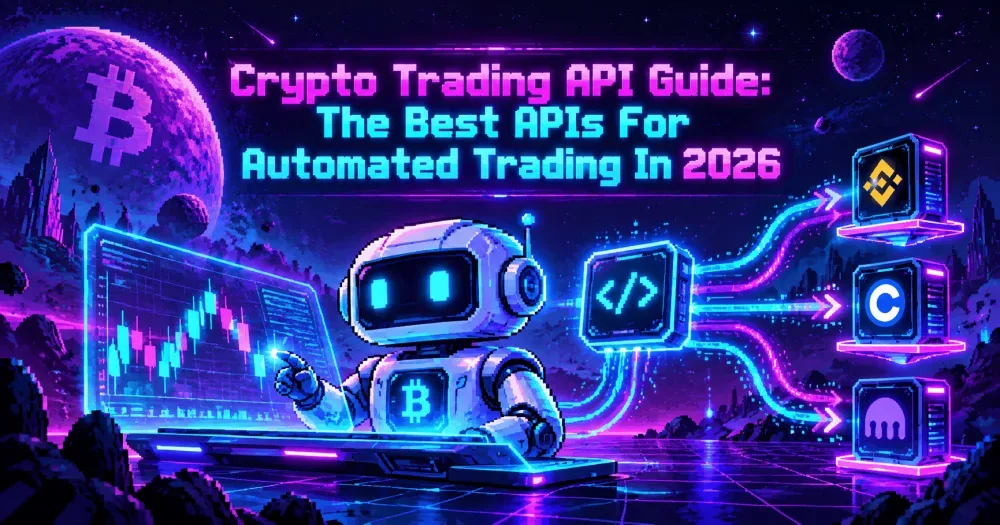
The top automated crypto trading APIs empower trading bots to outperform humans through continuous market monitoring, lightning-fast reaction speeds, and the ability to process hundreds of orders simultaneously.
API quality varies widely across the industry; while some platforms focus exclusively on basic REST requests, others support WebSocket order entry, institutional FIX connections, dedicated test environments, portfolio segregation, and elevated rate limits designed for professional setups.
Related: Crypto Wallet API: 7 Best APIs for Building Multi-Chain Wallets in 2026
What Is A Crypto Trading API?
A crypto trading API serves as a communication bridge linking your trading bot directly to an exchange.
Rather than manually clicking “Buy” or “Sell”, your trading software transmits structured requests to the exchange. Depending on the specific API capabilities, your bot can:
- Retrieve prices and order books
- Monitor balances and positions
- Place, amend, and cancel orders
- Track fills in real-time
- Manage stop-loss and take-profit orders
- Trade across multiple markets
- Collect historical data
- Run market-making, arbitrage, or algorithmic trading strategies
Most exchanges rely on REST APIs for standard request handling and WebSocket APIs for delivering continuous, real-time data streams.
Professional-grade platforms may also provide FIX connections, which are widely utilized by institutional financial trading environments.
Best Automated Crypto Trading APIs In 2026
| API | Best For | REST | WebSocket | Test Environment | Key Strength |
|---|---|---|---|---|---|
| Binance | High-volume global trading | Yes | Yes | Yes | Liquidity and API depth |
| Kraken | Advanced and institutional trading | Yes | Yes | Limited by product | Strong order and market-data tools |
| Coinbase | US-focused automated trading | Yes | Yes | Available on Exchange products | Clean infrastructure and institutional options |
| OKX | Complex multi-market strategies | Yes | Yes | Yes | Powerful order management |
| Bybit | Derivatives automation | Yes | Yes | Yes | Unified V5 API |
| Crypto.com | Straightforward exchange automation | Yes | Yes | Yes | High API throughput |
While these rank among the premier automated crypto trading APIs globally, regional availability varies. Platforms like Binance, OKX, Bybit, and Coinbase deliver differing product suites depending on the jurisdiction.
Binance API — Best for High-Volume Automated Trading
The Binance API stands out as one of the most comprehensive options for algorithmic crypto trading.
Its Spot API accommodates REST requests, real-time WebSocket streams, authenticated WebSocket trading, along with robust account and order-management capabilities. Furthermore, Binance maintains separate APIs tailored for derivatives and additional offerings.
The primary advantage lies in an infrastructure specifically optimized for heavy trading volume.
Instead of treating all requests equally, Binance employs weighted rate limits. Current Spot API documentation details a standard request-weight maximum of 6,000 per minute, though specific endpoints consume varying weights and account order limits remain separate.
Additionally, WebSockets stream order books, individual trades, account events, and execution updates seamlessly without necessitating constant REST endpoint polling.
Read more: Best Blockchain API Providers for Fast Web3 Data in 2026
Binance also supplies test environments for supported products, enabling developers to prototype strategies without exposing real capital to immediate risk.
Best for:
- Market-making bots
- Arbitrage systems
- High-frequency strategies
- Large numbers of trading pairs
- Developers needing granular market-data
Regulatory access presents the primary constraint. Binance product availability differs significantly by country, and Binance.US operates as a standalone platform featuring distinct markets and API functionalities.
Kraken API — Best for Advanced Order Management
Kraken has significantly upgraded its developer offerings to feature REST, WebSocket v2, and institutional FIX connectivity.
The WebSocket v2 architecture supports real-time trading paired with live market data. Features such as client order IDs and atomic amendments elevate order management for systematic trading models.
Atomic amend functionality is particularly crucial for market makers, permitting a bot to modify an active order efficiently rather than enduring the overhead of cancelling and re-submitting it.
Additionally, Kraken exposes Level 3 market data displaying individual orders within the book, assisting advanced systems in analyzing queue position, resting times, and projected execution outcomes.
Institutional clientele can leverage Kraken’s FIX 4.4 connectivity.
These attributes establish Kraken as a premier automated crypto trading API choice for execution-sensitive strategies.
Best for:
- Professional spot traders
- Market makers
- Order-book strategies
- Institutional integrations
- Bots needing detailed execution control
Coinbase Advanced Trade API — Best for US-Based Developers
Coinbase Advanced Trade delivers REST and WebSocket APIs tailored for programmatic order execution alongside real-time market feeds.
Its most prominent asset is the seamless alignment with the broader Coinbase trading ecosystem.
Coinbase maintains an official Python SDK alongside resources designed for TypeScript, Go, and Java. Developers can easily query product info, direct orders, track fills, and subscribe to real-time tickers, Level 2 order books, and user channels.
While the Advanced Trade API accommodates up to 100 portfolios, the standard Coinbase web interface currently restricts users to generating a maximum of 25.
Professional Coinbase Exchange products incorporate FIX connectivity paired with specialized institutional infrastructure.
Consequently, Coinbase represents an exceptional automated crypto trading API for developers prioritizing US market access and a regulated exchange backing.
Related: Best NFT API Providers In 2026: Data, Pricing, Chains, and Developer Fit
Best for:
- US-focused trading systems
- Developers starting with an official SDK
- Portfolio-separated strategies
- Institutional Coinbase users
The platform may prove less suitable for automated strategies searching for expansive access to emerging or lesser-known altcoins.
OKX API — Best for Complex Multi-Market Strategies
OKX features one of the market’s more sophisticated unified API frameworks.
The V5 interface encompasses spot markets, margin trading, futures, perpetual swaps, and options via both REST and WebSocket channels, while supporting diverse account configurations including portfolio margin.
For standard order routing, OKX currently permits up to 60 requests every two seconds per instrument under default guidelines. Batch endpoints handle multiple orders simultaneously, and sub-account parameters scale to support demanding architectures.
Furthermore, OKX supplies Demo Trading APIs, empowering bots to interact with simulated liquidity before deploying to production.
An additional standout feature is request expiration parameters. Developers can utilize an expTime tag instructing OKX to discard an order should network latencies cause delayed delivery.
This safeguard proves invaluable for high-speed systems where orders logical 500 milliseconds prior lose relevance.
Among top-tier automated crypto trading APIs, OKX excels for developers engineering strategies spanning complex derivatives and margin structures.
Best for:
- Futures and perpetual strategies
- Options
- Portfolio-margin systems
- High-volume order management
- Testing through simulated trading
Bybit API — Best for Derivatives Bots
Bybit’s V5 API integrates spot trading, perpetual contracts, futures, and options into a unified system.
The platform offers REST endpoints, public and private WebSocket streams, and independent WebSocket order entry paths. A dedicated testnet closely replicates live production environments.
Bybit’s standard HTTP architecture allows up to 600 requests inside a five-second window per IP address, subject to individual endpoint and account restrictions.
Its WebSocket architecture splits data feeds logically across spot, linear contracts, inverse contracts, options, and related instruments.
This setup makes Bybit an appealing choice for bots orchestrating leveraged exposures or reacting dynamically to derivatives data feeds.
Best for:
- Perpetual futures bots
- Options strategies
- Leveraged trading systems
- Developers wanting a broad testnet
Jurisdictional considerations remain crucial, as Bybit services are not universal across all countries.
Crypto.com Exchange API — Best Simple Alternative
Although Crypto.com often receives less developer attention compared to Binance or Kraken, its Exchange API remains robust.
It delivers REST and WebSocket interfaces for market data feeds, account particulars, and order execution, supported by a UAT sandbox environment.
Current documentation accommodates up to 15 order-creation requests per 100 milliseconds for authenticated REST trading, while the User API WebSocket supports significantly elevated transaction throughput.
These parameters render Crypto.com a practical option for automated spot architectures lacking the complexity of larger institutional gateways.
Best for:
- Conventional trading bots
- Developers wanting a sandbox
- Crypto.com Exchange users
- Relatively straightforward REST/WebSocket integrations
Read more: Recommended RPC Node Providers for Web3 in 2026: Tested Guide for TON, Celestia, and Multichain Teams
REST vs WebSocket: Which Should A Trading Bot Use?
Most professional-grade bots utilize both protocols in tandem.
REST is optimized for sporadic, discrete actions:
- Placing orders
- Requesting balances
- Downloading historical candles
- Retrieving configuration data
Conversely, WebSockets excel at streaming fast-changing variables:
- Live prices
- Trades
- Order-book updates
- Fills
- Position changes
Polling a REST endpoint hundreds of times per second would rapidly exhaust rate limits and introduce avoidable processing latency.
A standard system ingests live market data via WebSockets, processes internal logic decisions, and dispatches resulting orders through REST or WebSocket submission channels.
The most capable automated crypto trading APIs provide native support for both approaches.
What About CCXT?
CCXT is not a cryptocurrency exchange.
Rather, it functions as an open-source software library establishing a unified interface across numerous crypto trading platforms.
Instead of writing bespoke integration code for Binance, Kraken, OKX, and other exchanges individually, developers leverage CCXT to standardize core operations such as fetching tickers and submitting orders.
This makes the library exceptionally valuable for:
- Multi-exchange arbitrage
- Strategy prototyping
- Switching exchanges
- Maintaining one codebase
However, this level of abstraction carries trade-offs.
Platform-specific upgrades debut first within native APIs, and complex order schemas or high-performance WebSocket streams often demand direct platform integration.
CCXT is ideal for straightforward multi-venue bots, whereas latency-critical systems typically demand native APIs for maximum control.
Related: Best Prediction Markets APIs for Builders in 2026
How To Choose The Best Crypto Trading API
Evaluate these six essential factors when selecting an automation API:
- Liquidity: A technically superior API adds little value if the underlying strategy trades assets lacking deep liquidity.
- Rate Limits: High-frequency models frequently issue thousands of requests, making rate-limit design a critical determinant of strategy viability.
- WebSocket Reliability: Systems must reliably identify connection drops, missed updates, and stale data feeds.
- Order Types: Market makers may necessitate post-only instructions, immediate-or-cancel parameters, batch orders, amend triggers, or self-trade prevention features.
- Sandbox or Testnet: Simulated testing environments help unearth software bugs before real funds are deployed.
- API-Key Security: Trading credentials should strictly be assigned minimum required permissions. Withdrawal clearance is unnecessary for the vast majority of trading setups and introduces unnecessary exposure if keys are breached.
Which API Is Best For Automated Crypto Trading?
No single platform wins universally, as individual exchanges optimize for different use cases.
Binance delivers unmatched depth for high-volume global strategies; Kraken shines for advanced execution and order-book workflows; and Coinbase is tailor-made for US developers tied into institutional ecosystems. OKX provides power for multi-asset portfolio-margin systems, while Bybit caters directly to derivatives automation. Crypto.com supplies a reliable alternative featuring accessible REST and WebSocket tooling.
For numerous development teams, the optimal architecture incorporates multiple venues.
A sophisticated system might aggregate pricing feeds across several exchanges, spot an inefficiency, and route the order to whichever platform provides superior liquidity, favorable fees, and optimal execution quality at that exact moment.
Final Verdict: What Are The Best Automated Crypto Trading APIs?
The best automated crypto trading APIs in 2026 transcend simple interfaces designed merely to execute market orders.
Contemporary APIs consistently deliver streaming market feeds, WebSocket execution channels, testbeds, portfolio segregation, advanced order tools, and institutional protocols like FIX.
For both retail and professional builders, Binance, Kraken, Coinbase, OKX, and Bybit establish the core industry standard.
Selection should always follow the trading strategy.
A basic dollar-cost-averaging bot prioritizes execution reliability over raw speed. A cross-exchange arbitrage engine depends on multiple high-speed WebSocket connections. A market maker requires granular order management. A derivatives bot demands robust position and margin updates.
Ultimately, the ideal API is the one whose market infrastructure complements the specific algorithmic logic running upon it.
FAQ
What are the best automated crypto trading APIs in 2026?
Binance, Kraken, Coinbase Advanced Trade, OKX, and Bybit stand out as top choices, supplemented by Crypto.com’s reliable API offering.
Can a crypto API trade automatically?
Yes. Authenticated APIs empower automated software to place, modify, and cancel orders based on predefined trading algorithms.
Is WebSocket better than REST for crypto trading?
WebSockets are ideal for continuous, real-time data streaming, whereas REST remains efficient for individual command requests and account management tasks.
Is CCXT a crypto exchange API?
No. CCXT acts as a unifying wrapper library providing a standardized interface across multiple distinct exchange APIs.
Do automated trading bots need withdrawal access?
Generally, no. A trading bot typically requires only read and trade permissions; disabling withdrawal privileges minimizes potential losses if API keys become compromised.

Web3 PR Specialist | KOL | Blockchain Advocate | Digital Strategy Expert based in Moscow, Russia. Focused on Web3 communications, blockchain, digital strategy, and community growth.
More from this author
Comments 0 responses