
Eligible Bitcoin Holders Receive Equal ECX Balances in eCash Fork
LayerTwo Labs has launched the eCash Bitcoin fork, distributing native ECX tokens to eligible holders with direct control of their BTC private keys. The new network features five initial sidechains and uses BIP300 and BIP301.

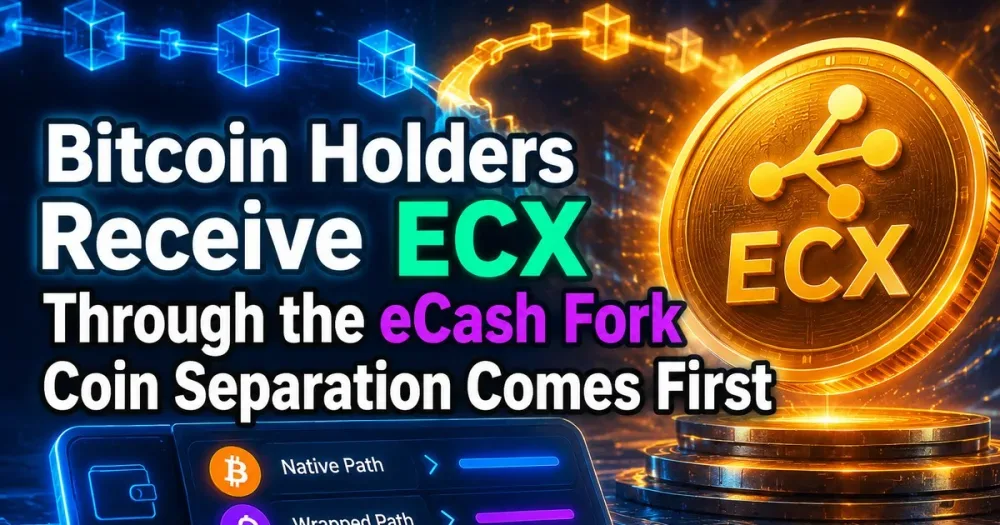
Paul Sztorc’s LayerTwo Labs officially introduced the eCash Bitcoin fork on October 29. Holders who had direct control of their BTC private keys at block 973,728 received a matching balance of native ECX tokens on the new network. This ECX crypto distribution mirrors coin totals rather than reflecting Bitcoin’s fiat dollar value.
For eligible holders, the immediate priority is safely separating the coins. While native ECX operates on the eCash blockchain, wrapped ECX (wECX) trades on Solana. Furthermore, access methods vary by custody; users holding BTC on a cryptocurrency exchange must wait for their specific platform to release its distribution policies.
What ECX Holders Received From the Bitcoin Fork
How did Bitcoin balances become ECX balances?
The fork was initialized using Bitcoin’s ledger state at block 973,728. According to LayerTwo Labs’ distribution details, individuals who managed the corresponding private keys were granted an identical amount of coins on the eCash ledger.
Related: New Bitcoin Fork ECash Promises Free Tokens, Split Set for August
Cointelegraph reviewed the October 29 launch parameters and holder access guidelines on November 7. This allocation provides eligible participants with an entirely separate asset, though liquidating it requires a compatible marketplace and the successful execution of coin separation steps.
What kind of asset is native ECX?
ECX serves as the native asset of eCash, a distinct hard fork built using modified Bitcoin architecture. It functions directly within the new network rather than operating as a token issued on the main Bitcoin blockchain.
The project’s intended use cases go far beyond standard mainchain coin transfers. Its Drivechain configuration allows developers to construct diverse sidechains geared toward payments, privacy features, digital assets, and prediction markets, each governed by independent transaction parameters.
Paul Sztorc’s Drivechain Plan Moves to eCash
Why did LayerTwo Labs create a separate network?
As the founder of LayerTwo Labs, Sztorc is the primary architect behind the Bitcoin Drivechain proposals known as BIP300 and BIP301. He spent over a decade advocating for Drivechains before ultimately bringing eCash to life.
He views Bitcoin’s traditionally conservative development pace as a barrier to broader network adoption. Initiating this fork gives his team an independent environment to explore custom applications and sidechains instead of waiting for the main Bitcoin protocol to implement such updates.
What protocol changes does the project describe?
The project highlights eCash as an activation of BIP300 and BIP301. This enables multiple competing sidechains to run under their own rules while keeping the core base layer streamlined, allowing Bitcoin to move forward on its separate path.
Published technical specifications note a tenfold reduction in base-layer block sizes alongside blind merged mining, which permits miners to collect sidechain transaction fees. Additionally, the developers state that eCash features zero premine allocations or developer funds.
ECX Utility Starts With Five Sidechains
What applications launched with the network?
The eCash mainnet debut was accompanied by five distinct sidechains: BitNames, BitAssets, Thunder, Truthcoin, and zSide. Together, these make up the initial suite of applications anchored to the new mainchain.
Project documentation and software portals outline two foundational paths for users: transferring native ECX on the mainchain or utilizing sidechains governed by distinct processing rules. Target use cases span payments, data privacy, alternative digital assets, and prediction markets.
<
What comes after the initial sidechains?
Two additional protocols are already mapped out for the future: Photon, designed to be quantum-resistant, and CoinShift, a decentralized exchange. These remain upcoming additions rather than components of the initial five-sidechain release.
Sztorc points to paying customers and steady transaction-fee generation as the primary metrics for success during the first year. Consequently, the ultimate test rests on commercial application adoption and organic utility rather than the sheer volume of Bitcoin holders who received copied balances.
ECX Pricing Requires Care With Asset Identity
How has the project described early trading?
LayerTwo Labs reports that early ECX trading values fluctuated between $40 and $50. This figure represents the company’s internal characterization of early activity rather than a confirmed November 7 price quote or a verified all-time high.
Achieving a practical sale price depends heavily on the chosen exchange venue, the precise form of the asset delivered, and prevailing order quotes. The official eCash platform explicitly classifies its purchase estimates as indicative figures that exclude associated network fees and price impacts.
<
Why is the native-versus-wrapped distinction important?
Native ECX strictly resides on the eCash network. Conversely, the project describes wECX as a wrapped asset issued on Solana and stored within Solana-compatible digital wallets, offering alternative exposure to ECX.
Therefore, prospective buyers must carefully verify both the asset type and its destination network before evaluating price quotes. Simply searching for the ECX ticker symbol can also yield an unrelated token listing on Solana.
Accessing ECX Starts With Safe Coin Separation
What should self-custody holders use?
Self-custody participants require an eCash-compatible software wallet and must complete the project’s designated coin-separation protocol. Official web portals provide direct access to wallet downloads, coin-splitting guides, user dashboards, and block explorers.
These instructions are critical because eCash and Bitcoin share a common early transaction ledger. LayerTwo Labs confirms that automated replay protection mechanisms are embedded in the protocol, but still strongly advises users to split their ECX tokens prior to spending their underlying BTC balances.
Why does the order of transactions matter?
Executing an unprotected transaction on one network risks getting automatically mirrored or “replayed” on the other. LayerTwo Labs cautions users never to move their BTC first, explaining that an ordinary, unsecured Bitcoin transfer can accidentally execute on the eCash side.
The company’s standard operational recommendation is to move ECX assets first. Holders should strictly follow published wallet and splitting guides instead of improvising custom transaction steps.
How does exchange custody change access?
Individuals who store their BTC on centralized cryptocurrency platforms are entirely subject to the fork policies of those specific custodians. Holding a balance on an exchange differs fundamentally from directly managing the underlying private keys required for the snapshot.
Exchange users should consult their platform’s formal customer support bulletins and distribution notices. Depending on the user’s jurisdiction, hard forks can also trigger complex tax reporting liabilities, making regional tax compliance an essential factor before attempting to access or liquidate ECX.
ECX Risks Include Replay Exposure and Sidechain Security
What is the Drivechain security dispute?
Detractors of the Drivechain architecture contend that malicious miners could theoretically collude to misappropriate funds stored within sidechains. This criticism targets the security integrity of sidechain assets rather than merely questioning the existence of the copied mainchain balance.
Sztorc dismisses these security warnings, arguing that miners would ultimately undermine their own business models by attempting short-term theft. He frames miner economic incentives as a reliable safeguard for the protocol design. Consequently, token holders navigate a contested security framework rather than an absolute guarantee.
What risks arise from a same-name Solana market?
A completely separate Solana-based asset bearing the eCash name and the ECX ticker launched a PumpSwap liquidity pool on October 10—less than a month prior to November 7. DEX Screener data highlights roughly $5,200 in liquidity for this specific trading pair, though any official tie to the native fork or wrapped wECX remains unconfirmed.
Due to its recent creation and shallow liquidity, relying solely on the token ticker creates substantial financial risk: traders risk severe slippage and may inadvertently purchase the incorrect asset. These market cautions apply specifically to the unrelated Solana token rather than the valuation of native eCash.
What could help or hinder lasting demand?
Meaningful sidechain adoption coupled with broader exchange listings could provide users with more practical incentives to hold and utilize ECX. Sztorc notes that his team continues pursuing additional exchange integrations while keeping its primary first-year evaluation metrics fixed on active paying users and fee generation.
Conversely, downward pressure may stem from cumbersome coin separation procedures, custodial delays, and lackluster demand for applications. While a snapshot grants an initial allocation, developers must still build compelling services that attract active transaction participants.
Where Native ECX and Wrapped wECX Can Be Traded
Which venues announced native ECX access?
NeoxEX reported the launch of native ECX deposits, withdrawals, and spot trading on October 29, supporting trading pairs for ECX against USDT, USDC, and BTC.
CoinW also announced intentions to distribute ECX to eligible Bitcoin holders, noting that exact deposit, withdrawal, and trading market schedules would be published at a later date. This commitment to future distribution is separate from an active live market.
What Solana routes are described for wECX?
Orca hosts a dedicated liquidity pool allowing users to swap USDC for wrapped ECX on the Solana network. This constitutes trading in wECX rather than handling native ECX on the eCash blockchain.
Additionally, the official eCash website facilitates USDC-to-wECX conversions via SideShift, depositing the resulting wrapped tokens directly into the user’s Solana wallet. The Orca liquidity pool and the website’s SideShift mechanism represent two entirely distinct access routes.
What should buyers check before accepting a quote?
Traders must first verify whether a venue delivers native ECX or Solana-based wECX. The destination wallet software and selected blockchain network must correspond precisely with the asset being provided by the platform.
Next, participants should scrutinize the actual executable quote, accounting for network fees and expected market impact. Because the project labels its web-based estimates as purely indicative, portal projections serve merely as a baseline rather than the final execution amount.
What Should ECX Holders Watch Next
Upcoming announcements from CoinW, further exchange listings, and the development of the Photon and CoinShift sidechains represent tangible milestones to monitor. Each factor expands a different facet of the ecosystem, encompassing custody access, market liquidity, and application features.
Ultimately, the long-term test aligns with Sztorc’s stated emphasis on paying users and steady fee revenue. The future trajectory of ECX depends heavily on whether this newly formed network can convert its launchside applications into sustained, organic usage alongside safe asset retrieval for early participants.
FAQ
Which Bitcoin block determined eligibility for ECX?
The allocation relied on Bitcoin block 973,728. LayerTwo Labs confirms that individuals controlling their BTC private keys at that specific ledger height received an equivalent quantity of native ECX coins.
Who developed the eCash fork?
The eCash fork was developed by LayerTwo Labs under the leadership of founder Paul Sztorc, whose foundational work on the BIP300 and BIP301 Drivechain proposals shapes the network’s sidechain-centric model.
Which five sidechains launched alongside eCash?
The initial launch lineup comprised BitNames, BitAssets, Thunder, Truthcoin, and zSide, while Photon and CoinShift were highlighted separately as planned future upgrades.
Why does LayerTwo Labs advise separating ECX before spending BTC?
The company warns that an unsecured Bitcoin transaction can be accidentally replayed on the eCash network due to their shared historical ledger data, instructing users to complete the native ECX separation protocol first.
Which native ECX trading pairs did NeoxEX announce?
NeoxEX launched native ECX markets paired against USDT, USDC, and BTC, with deposits, withdrawals, and spot trading opening concurrently on October 29.
What has CoinW announced for eligible Bitcoin holders?
CoinW announced a planned ECX token distribution for qualifying holders, though specific timelines regarding deposits, withdrawals, and active trading markets were reserved for subsequent announcements.
Does wECX bought through the eCash website stay on Solana?
Yes. Official documentation confirms that purchases completed via the website’s SideShift integration route deliver wECX tokens directly to a Solana-compatible wallet, keeping them separate from the native eCash blockchain.
This article is for information only and is not financial advice.

Web3 PR Specialist | KOL | Blockchain Advocate | Digital Strategy Expert based in Moscow, Russia. Focused on Web3 communications, blockchain, digital strategy, and community growth.
More from this author
Comments 0 responses