
Fed Pauses Rate Hikes After September Increase in 10-2 Vote
The Federal Reserve kept its benchmark interest rate at 3.75% to 4% in a 10-2 vote following a September increase. Chair Kevin Warsh defended the pause, while Lisa Cook and Beth Hammack dissented in favor of a quarter-point hike.

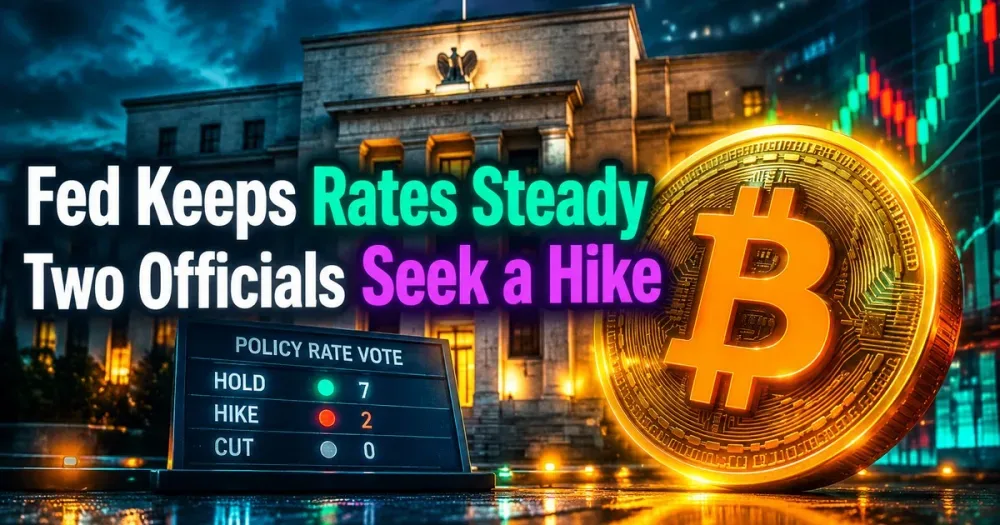
The Federal Reserve kept its benchmark interest rate at 3.75%-4% on October 28, 2026, in a 10-2 vote. Governor Lisa Cook and Cleveland Fed President Beth Hammack wanted a quarter-point increase. The Fed rate decision pauses the tightening that resumed in September, but leaves another hike on the table for December.
Chair Kevin Warsh said the central bank remains responsible for bringing inflation down. The expected hold gives policymakers more time to assess incoming economic figures. Cook and Hammack, however, wanted borrowing costs higher now.
Fed Rate Decision: Holds at 3.75%-4% After September’s Increase
What did the Fed decide on October 28?
The committee left the federal funds target range unchanged at its Wednesday meeting. Ten policymakers backed the pause. Cook and Hammack preferred a hike to 4%-4.25%.
Read More: How Federal Reserve Policy in 2026 Is Shaping Bitcoin’s Next Move
September brought the Fed’s first increase since 2023, with all policymakers in favor. In October, the majority chose to wait, even as the committee described economic activity as strong and inflation as elevated.
How widely expected was the pause?
CME FedWatch put the odds of no change at around 90% before the 2 p.m. ET announcement. Markets had clearly priced in a hold, though another increase before year-end remained a concern.
The bigger question was whether the statement and Warsh’s remarks would bolster expectations for December tightening. Even an expected pause can leave crypto and other risk assets facing a restrictive policy outlook.
Warsh Defends the Pause as Cook and Hammack Seek Action
How did Kevin Warsh explain the decision?
Warsh called the US economy resilient and linked elevated inflation and financial uncertainty to geopolitical developments. He framed the decision as part of the committee’s broader strategy, not a response to a particular date or economic release.
“It’s our responsibility to get inflation down,” he said at the press conference, according to CryptoPotato. Americans, he added, had been dealing with inflation above the committee’s objective for close to six years.
Asked why policymakers might wait now and raise rates in December, Warsh pointed to monetary policy’s objectives. The next move will depend on how the inflation and economic outlook develops.
Why do the dissenting votes matter?
Cook and Hammack wanted to keep tightening immediately after September’s increase. Their preferred quarter-percentage-point hike would have lifted both ends of the target range.
It was the first time since 1992 that a Fed governor and a regional bank president dissented together on the same side, according to Bitcoin Magazine. The majority still carried the decision, but the pairing marked an unusual split.
What did Warsh say about political pressure?
Warsh said “politics played no role” in the decision when asked about President Donald Trump’s calls for lower rates. The meeting came days before the November 3 midterm elections.
He has also said he is reluctant to offer forward guidance outside a crisis. Investors are watching incoming releases and the committee’s inflation objective, rather than relying on a promised timetable for the next move.
July’s Split Hold Led to a Unanimous September Hike
What happened at the July meeting?
On July 29, the Fed held its target range at 3.50%-3.75% in a 9-3 vote. Hammack, Minneapolis Fed President Neel Kashkari and Dallas Fed President Lorie Logan wanted a quarter-point increase, according to Reuters’ account of the meeting.
Officials disagreed over whether persistent price pressures demanded immediate action. Oil supply disruptions and the inflation outlook were already shaping the debate over how long they could wait.
At the July press conference, Warsh welcomed the internal disagreement, calling it “a real family fight,” according to Yahoo Finance. He said debate within the committee could improve policy decisions.
What changed between July and October?
In September, all 12 policymakers voted to raise rates, ending a period without an increase that had lasted since 2023. Minutes from that meeting showed most officials thought another hike would likely be appropriate by year-end.
October brought another split over timing. Hammack again favored a hike; Kashkari and Logan backed the hold, while Cook joined Hammack in dissent.
July’s divided pause gave way to September’s unanimous increase, then October’s divided pause. Policymakers have backed waiting at one meeting while supporting tighter policy at the next.
Strong Growth and Elevated Inflation Keep Tightening in Play
What changed in the Fed’s economic assessment?
The October statement upgraded its description of economic activity from a “solid” pace in September to a “strong” one. It also said job gains had kept pace with the workforce and unemployment had changed little.
That mix gives the Fed room to focus on inflation without citing a sharp employment downturn as the reason to pause. Warsh’s description of a resilient economy echoed the statement.
The committee dropped earlier language about when a hike might support a return to its inflation objective. Instead, it said more information would help determine the appropriate policy stance.
Which inflation pressures are keeping officials concerned?
Consumer prices rose 3.7% in the 12 months through September, and gasoline prices climbed 9.1% that month. Inflation remained above the committee’s 2% goal as officials weighed another rate increase.
US crude settled at $99.90 a barrel on October 27. The US-Iran war has squeezed global oil supply, pushing up fuel and shipping costs that can flow through to consumer prices.
Those energy costs complicate the decision. Activity remains strong as inflation stays elevated, and Warsh has pointed to geopolitical developments as a continuing source of uncertainty.
Bitcoin Faces High Treasury Yields Alongside ETF Demand
Why does this Fed decision matter for Bitcoin?
Bitcoin traded at $81,087 at 22:28 UTC on October 28, up approximately 0.31% over 24 hours, according to CoinGecko. The modest daily move left the policy outlook, rather than a sharp price reaction, at the center of the story.
Another increase would extend the pressure from high interest rates. Bitcoin pays no yield, while government debt offers investors interest, making Treasury returns relevant to demand for riskier investments.
The 10-year Treasury yield closed October 27 at 4.99%, after reaching 5.31% on October 5. Those returns formed part of the investment backdrop as the Fed considered whether inflation warranted another hike.
What recent buying has supported crypto demand?
Spot Bitcoin ETFs drew $110 million in net inflows on October 26 and $176 million on October 27. That put combined inflows at $286 million over the two sessions before the decision.
The inflows show that investment-product demand persisted despite the prospect of tighter policy. Continued buying could offset some of the pressure from high yields and uncertainty over December.
Risks Center on Inflation Persistence and December Expectations
How likely was another increase before the decision?
Before Wednesday’s announcement, markets put the odds of a quarter-point increase at the December meeting above 70%. September’s minutes also showed that most officials thought another increase would likely be appropriate by year-end.
December tightening remains firmly in play, but officials will weigh the information released before the meeting. The October statement tied the appropriate policy stance to the arrival of more data.
Strong activity and stubborn inflation would bolster the case for a hike. A more favorable inflation trend would give officials more reason to extend the pause.
What could make the coming weeks difficult for crypto investors?
Energy costs, inflation releases and employment figures can all shift expectations for how restrictive policy needs to be. Warsh has avoided firm forward guidance, leaving each major release important to the next decision.
Fed communications have also coincided with sharp crypto volatility. Approximately $481 million in crypto positions were liquidated in the 24 hours after Warsh’s Jackson Hole speech in August, a recent example of the exposure around major policy events.
Steady ETF demand could absorb some selling pressure. Hotter inflation or rising expectations for a hike could instead weigh on crypto appetite. Both investment flows and the policy path will shape the balance.
November Data Comes Before the December 8-9 Meeting
Which releases will shape the next rate decision?
The October jobs report is due November 6, followed by October inflation data on November 10. Both releases will inform the Fed’s assessment of employment and price stability.
The jobs figures will update the committee’s view that hiring has kept pace with the workforce. Inflation data will test whether price pressures are moving toward the 2% objective after September’s elevated reading.
The November 3 midterm elections come first, putting another political event on crypto investors’ calendar. Warsh has said politics played no role in October’s policy choice.
What will the Fed decide in December?
The committee meets next on December 8-9 and is scheduled to publish new economic projections. By then, officials will have the November releases as they consider whether another increase is needed.
October’s pause left open the question of whether to tighten, while September’s minutes showed a year-end preference for another hike. New projections will accompany the decision and provide a wider view of officials’ economic outlook.
Crypto holders will be watching whether incoming figures bolster Cook and Hammack’s case or support another pause. October kept both options open, with rates unchanged from their post-September level.
FAQ
Which officials voted for a rate increase?
Governor Lisa Cook and Cleveland Fed President Beth Hammack opposed October’s hold. Hammack had also sought an increase in July, when three officials dissented.
What interest-rate range did the dissenters prefer?
They favored a 4%-4.25% target range. That would have added a quarter of a percentage point to the range established by September’s increase.
When did the Fed last raise rates?
The previous increase came in September 2026 with all 12 policymakers voting in favor. It was the Fed’s first hike since 2023.
What inflation goal is the Fed trying to reach?
The committee aims for 2% inflation. September consumer inflation was 3.7% year over year, keeping price stability central to the discussion.
When are the next jobs and inflation reports due?
The October employment report is scheduled for November 6, with October inflation figures due November 10. Both arrive before policymakers gather for their December decision.
When is the next Fed meeting?
The next meeting takes place December 8-9, 2026. The Fed will also issue new economic projections alongside the rate announcement.
How much entered spot Bitcoin ETFs before the decision?
The funds received $286 million in combined net inflows on October 26 and 27. The larger of the two daily inflows was October 27’s $176 million.
What is the primary factor the Fed is monitoring to guide future rate changes?
The Federal Reserve is closely watching incoming inflation trends, employment figures, and broader economic resilience as it evaluates whether to adjust rates.
Did political pressure influence the October rate decision?
Fed Chair Kevin Warsh explicitly stated that politics played no role in the October rate decision.
This article is for information only and is not financial advice.

Web3 PR Specialist | KOL | Blockchain Advocate | Digital Strategy Expert based in Moscow, Russia. Focused on Web3 communications, blockchain, digital strategy, and community growth.
More from this author

Comments 0 responses