
KuCoin Suspends All Services for Users in Russia and Belarus
Cryptocurrency exchange KuCoin has suspended all products and services for users in Russia and Belarus, citing legal and compliance obligations, and provided instructions for impacted customers to withdraw assets.

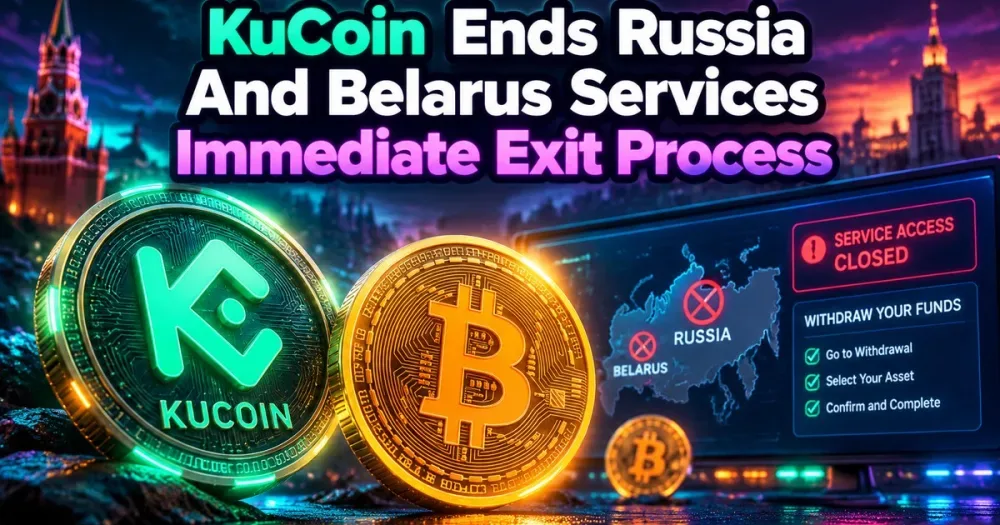
KuCoin immediately halted every product and service for users located in Russia and Belarus on Thursday, October 29, 2026, citing regulatory and legal compliance. The exchange announced that impacted customers would be given personal instructions and deadlines to liquidate positions and withdraw their assets.
This move places KuCoin alongside several other major trading platforms that have recently limited their services in these two nations. Account holders who obtain a notice must comply with its directives, whereas KuCoin noted that users who do not get a notice are not required to take any action at this moment.
KuCoin’s Suspension Covers Every Product and Service
The halt went into effect immediately for users residing in both countries. KuCoin characterized the user transition as an “orderly exit process,” featuring notifications that outline how and when impacted users can cash out funds and close positions.
Read More: Crypto Exchange Battle 2026: KuCoin vs OKX — Where Do Traders Prefer to Trade?
Rather than identifying a particular law, regulator, or specific sanctions designation, the company’s public announcement provided a general compliance justification. KuCoin stated that compliance dictates its service locations and methods, adding that its support staff will remain accessible to impacted customers throughout the migration.
In an X post published Thursday, the platform stated: “Compliance is at the core of our operations and guides our decisions on where and how we offer our services.”
KuCoin confirmed it blocked access to all its offerings for clients in Belarus and Russia while offering a mechanism to retrieve assets. Although the announcement outlines an exit path, it does not establish a single universal deadline for all accounts.
KuCoin Joins a Wider Retreat by Crypto Exchanges
Headquartered in the Seychelles, KuCoin claims a global base exceeding 45 million users. The restriction impacts solely individuals residing in Russia and Belarus, and the release does not indicate a global shutdown or alterations to services in other territories.
According to The Moscow Times, KuCoin ranked eighth on CoinMarketCap with daily trading volumes hovering around $1.2 billion. Other top-10 platforms like MEXC and Bitget also appeared on the list, meaning these withdrawals involve prominent industry trading hubs. The volume metric reflects enterprise-wide activity rather than specific trading figures from the two targeted nations.
Rival platforms enacted comparable measures over the course of the month. Following a terms update on October 16, Bitget restricted clients in Kazakhstan, Belarus, and Russia. Shortly after, MEXC stated it would cease operations for Belarusian and Russian users on October 20, making KuCoin the most recent major venue to enforce regional limits.
Both competitors mentioned international regulatory standards, ensuring customers had adequate time to withdraw balances and close open trades. These disclosures occurred within a two-week window ahead of KuCoin’s announcement, though Bitget’s limitations also encompassed Kazakhstan.
This trend follows Western financial penalties placed on Russian institutions following the February 2022 invasion of Ukraine. The European Union initially introduced crypto sanctions in 2022, and its July 2026 package aimed at overseas digital asset platforms introduced authorities to restrict alternative providers utilized for sanctions evasion.
The July updates featured transaction bans involving 14 foreign crypto platforms, expanding the regulatory framework outside EU borders while establishing tools to penalize additional overseas services linked to evasion.
While these events offer background for KuCoin’s choice, the platform did not assert that a distinct government mandated its exit. Its commentary pointed generally to applicable legal and regulatory obligations without naming the precise rule behind the shutdown.
Earlier Restrictions Put the Exit in Context
KuCoin had already introduced stricter limits on transfers tied to specific counterparties. Following the EU’s adoption of its 21st sanctions package against Russia on July 23, the platform began blocking direct and indirect transactions associated with HTX, Rapira, and A7-linked entities.
The EU’s July initiative targeted A7—characterized as a $120 billion crypto network—and penalized HTX for allegedly helping bypass Russian sanctions, barring European enterprises from interacting with it. Consequently, HTX featured prominently in both European directives and KuCoin’s subsequent counterparty filters.
An advisory published September 29 expanded the prohibited counterparty roster, cautioning that using intermediary wallet links could trigger account restrictions or reviews. These actions demonstrate that KuCoin mitigated sanctions risks prior to issuing a nationwide service cutoff.
European regulatory oversight has likewise impacted KuCoin’s regional footprint. In February, Austrian financial authorities restrained new business activities at the exchange’s European subsidiary due to shortcomings in sanctions-compliance and anti-money-laundering appointments. Although the regulator reversed this restriction in May, separate operational limits remained in effect.
Furthermore, KuCoin carries a history of enforcement actions, including a U.S. criminal settlement. In January 2025, the platform agreed to disburse nearly $300 million after pleading guilty to running an unlicensed money transmission business within the United States. This domestic case adds a separate regulatory milestone to the firm’s compliance background.
In March 2026, the Commodity Futures Trading Commission prohibited KuCoin’s parent operator from providing services to U.S. residents unless it registers as a foreign board of trade. While that restriction created a formal registration pathway for U.S. access, KuCoin’s statement regarding Russia and Belarus outlined no comparable procedure for restoring operations.
CoinDesk categorized KuCoin’s departure as part of a wider withdrawal from jurisdictions susceptible to Western sanctions, noting that the exchange failed to single out a specific mandate for its choice. Historical precedents include Binance’s sale of its Russian arm to CommEX in September 2023 over compliance anxieties—a venture that closed down six months later.
What the Customer Figures Can—and Cannot—Show
KuCoin has not released a breakdown of impacted accounts per country. Although it reports more than 45 million worldwide users, this aggregate statistic does not specify how many account owners reside in Belarus or Russia.
Analytics firm Semrush estimated that Russian visitors accounted for 1.03 million visits to KuCoin’s website in September—representing 3.93% of global web traffic and making Russia the platform’s third-largest source of web visitors. Traffic volume differs from unique visitors or active accounts, and these metrics exclude mobile application usage.
Multiplying that traffic share by KuCoin’s reported global user count yields a rough baseline of roughly 1.77 million Russian sign-ups. This is not an exact account tally, since website hits can include repeat visitors, and some registered individuals may be dormant. The total count of affected Belarusian users remains absent from this calculation.
Separately, on October 29, the Central Bank of Russia authorized the National Association of Securities Market Participants (NAUFOR) to act as a self-regulatory organization for digital asset custodians and exchanges. The central bank registry encompassed eight digital custody providers and 23 crypto exchanges, mandating that registered firms join a self-regulatory body within a 90-day window. This local regulatory update remains entirely distinct from KuCoin’s stated rationale for exiting.
Why the Exit Matters and What Users Should Do
For impacted clients, the priority is executing the actions detailed in KuCoin’s specific notice: close open trades and withdraw funds within the designated window. Because the exchange promised support channels and instructions, customers should consult their personal notifications for account-specific guidelines rather than assuming a uniform deadline applies globally. Users must also remain vigilant against scam messages promising expedited withdrawals or requesting security credentials, relying instead on official exchange support channels.
A broader consequence is the shrinking array of international exchanges available to users in Belarus and Russia. With MEXC and Bitget introducing limits throughout October, KuCoin’s shutdown incorporates yet another massive venue onto that roster. This pattern highlights how compliance mandates and sanctions exposure dictate where digital asset companies choose to operate.
For crypto firms, the development underscores the practical reach of sanctions beyond entities rooted in Europe or the United States. Across the industry, observers are watching whether other trading venues will adjust access for users in the area, following the October actions by MEXC and Bitget. Meanwhile, Russian custodians and registered exchanges must adhere to the central bank’s 90-day requirement to affiliate with NAUFOR following its official approval.
BeInCrypto connected KuCoin’s earlier counterparty blocks and recent exchange retreats to the increasingly stringent sanctions climate. Conversely, BestChange senior analyst Nikita Zuborev attributed the platform departures to escalating compliance expenses and secondary sanctions risks—representing an external interpretation rather than KuCoin’s official rationale.
Zuborev’s commentary highlighted the commercial hazards confronting platforms that continue servicing these regions, whereas KuCoin’s press release left the precise legal catalyst unstated.
FAQ
- When did KuCoin suspend services in Russia and Belarus? The suspension took effect immediately on Thursday, Oct. 29, 2026. It applies to users based in both countries across KuCoin’s products and services.
- What happens to affected accounts and assets? Affected customers will receive individual instructions and deadlines to close positions and withdraw funds. KuCoin said it would offer an orderly exit process that allows users to withdraw assets according to the notice they receive.
- Do customers who have not received a notice need to act? KuCoin said users who have not received a notice do not need to take action at this stage. The exchange said it would contact affected customers with instructions.
- Does this affect KuCoin’s operations outside Russia and Belarus? No. The suspension is limited to customers based in Russia and Belarus. KuCoin says it has more than 45 million users globally, and the announcement does not describe a change to service elsewhere.
- Which other exchanges restricted users in the region? Bitget restricted users in Russia, Belarus and Kazakhstan after an Oct. 16 terms update. MEXC announced its Russia-Belarus exit on Oct. 20.
- What reason did KuCoin give for the suspension? The exchange cited applicable legal and regulatory requirements and described compliance as central to its decisions about where it operates. It did not name a specific law, regulator or sanctions measure.
- How many Russian users does KuCoin have? KuCoin has not published a country count. Semrush estimated Russian users generated 3.93% of KuCoin’s September web traffic, which would suggest roughly 1.77 million Russian registrations if applied to KuCoin’s 45 million global users, though that is an illustrative estimate, not an account count.
This article is for information only and is not financial advice.

Web3 PR Specialist | KOL | Blockchain Advocate | Digital Strategy Expert based in Moscow, Russia. Focused on Web3 communications, blockchain, digital strategy, and community growth.
More from this author


Comments 0 responses