
RLC Crypto Surges 146%: What’s Behind iExec’s Massive Price Rally?
RLC crypto surged roughly 146% over three months, driven by an October 5 price breakout, heavy leveraged speculation, a short squeeze, and interest in iExec's confidential computing network.

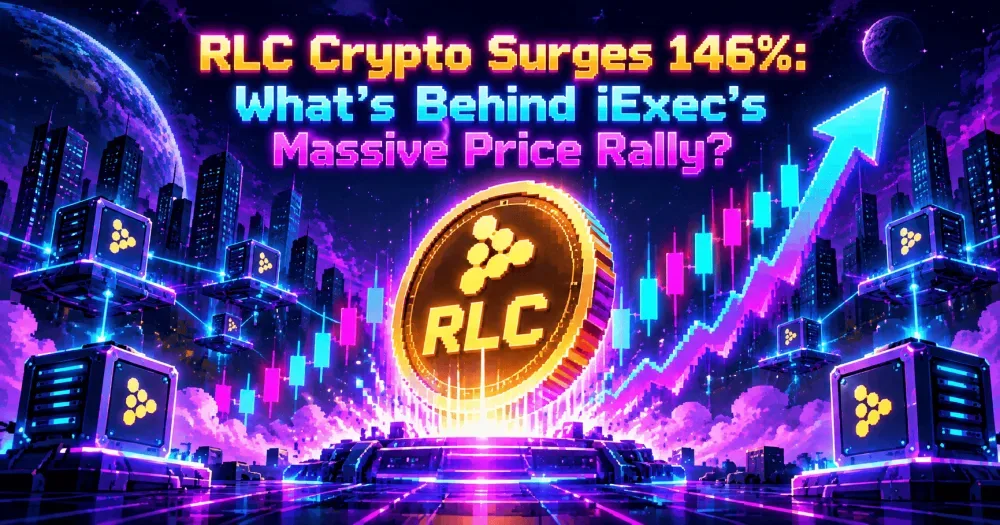
RLC crypto has emerged as one of the market’s most aggressive movers. The iExec token has gained roughly 146% over three months, driven largely by a dramatic October 5 breakout that nearly doubled its price in a single day.
The RLC price climbed from about $0.36 to over $0.70, touching much higher levels intraday. This begs the question of why the token is appreciating and whether this momentum can last.
Related: Trump Just Sent Hyperliquid (HYPE) Soaring: Is a U.S. Breakthrough Coming?
What Is RLC Crypto?
RLC functions as the utility token for iExec, a decentralized computing platform that launched back in 2017.
The network centers on confidential computing, enabling data processing without exposing sensitive details during execution.
This capability applies to fields such as:
- Artificial intelligence
- DeFi
- Real-world assets
- Data monetization
- Private financial applications
- Decentralized computing
iExec leverages Trusted Execution Environments (TEEs) to protect sensitive workloads while they execute.
Underlying this entire infrastructure is the RLC crypto token.
iExec states that RLC facilitates access to computing power, secures off-chain computations, and helps monetize digital assets.
The total supply is capped at approximately 87 million RLC, devoid of inflation or upcoming token unlocks.
Why Is RLC Crypto Surging?
The peculiar aspect of this upward move is the lack of a distinct single catalyst.
iExec did not announce a major partnership on October 5, nor was there a prominent new token listing that suddenly put RLC in front of millions of new traders, nor did the project roll out a revolutionary product capable of doubling its market value overnight.
Consequently, market structure takes center stage.
Prior to the surge, RLC crypto spent a significant portion of September changing hands between roughly $0.28 and $0.38.
Then market activity shifted almost instantly.
On October 5, RLC opened near $0.36 before pushing above $0.70, with certain exchanges recording an intraday high nearing $0.98.
Trading volume escalated even more sharply.
Such a pairing—an explosive price action alongside an even greater spike in volume—frequently indicates that speculative capital has targeted a relatively illiquid asset.
RLC is small enough for this dynamic to matter, boasting a market capitalization of only about $30 million before the rally began.
Is a Short Squeeze Driving the RLC Rally?
Derivatives trading surrounding RLC surged in tandem with spot market activity.
Data from Coinalyze revealed that RLC open interest climbed from around $2 million prior to the breakout to nearly $38 million, marking an increase exceeding 1,800% within a 24-hour window.
This magnitude is extraordinary relative to the underlying asset’s size.
Open interest reflects active futures contracts.
While it does not specify whether traders hold bullish or bearish stances on its own, such a massive surge demonstrates that leveraged speculation flooded the market rapidly.
Furthermore, RLC exhibited heavily negative funding rates leading up to the breakout.
Negative funding generally signifies that perpetual futures traders favor short positions.
When prices break upward unexpectedly, those short sellers may be forced to buy RLC to cover positions or face liquidation.
This triggers a continuous loop:
- Spot buying drives RLC higher
- Short positions fall into negative PnL
- Shorts cover or face liquidation
- Those buy orders push RLC up further
- Momentum traders jump in
- Additional short positions face vulnerability
For a smaller-cap token, this sequence can have a severe impact.
Why Is iExec Suddenly Interesting Again?
While the rally may be speculative, the fundamental narrative did not materialize out of thin air.
iExec points out that public blockchains present a fundamental challenge for institutional users: transactions are verifiable, but private balances, proprietary trading strategies, and confidential financial records are exposed.
The proposed remedy is confidential execution.
Earlier in the year, iExec unveiled its Confidential Token framework, built to allow ERC-20 assets to mask balances and transaction volumes while maintaining selective disclosure capabilities for authorized entities like regulators or auditors.
The network has also focused on building out confidential AI infrastructure alongside collaborations with decentralized computing providers like Aethir.
Related: Best Polymarket Trading Bots in 2026: Top Bots for Copy Trading, AFK Trading and Telegram Automation
These efforts place iExec right at the crosssection of several trending crypto sectors:
- AI
- DePIN
- Privacy
- Real-world assets
- Institutional DeFi
Through RLC crypto, participants gain a lower-cap instrument to speculate on all these domains simultaneously.
Why RLC Tokenomics Matter
The supply design of RLC can amplify both upward and downward price action.
With a maximum ceiling near 87 million tokens, nearly the entire supply is already in circulation.
As a result, RLC crypto avoids the heavy scheduled token unlocks that typically burden newer projects.
Holders face no persistent stream of newly vested tokens entering circulation to dilute their stakes.
Additionally, iExec has discussed tying future network utility more directly to demand for RLC.
In the proposed model for confidential DeFi infrastructure, end users would not strictly need to hold RLC tokens directly; instead, protocol revenues could be funneled into automated open-market purchases of RLC.
In theory, this addresses a longstanding hurdle associated with utility tokens.
Normally, for adoption to drive value to a token, participants must actively interact with the token itself.
iExec’s architecture aims to let institutional users interact with the system normally while the underlying mechanics handle RLC demand in the background.
However, this mechanism only holds weight if iExec achieves substantial adoption and fee generation.
At present, this value proposition remains speculative.
Does the 146% Rally Mean iExec Adoption Is Exploding?
No.
A 146% surge in RLC crypto demonstrates heightened demand for the asset itself, but it does not indicate that utility of iExec’s network grew by 146%.
Little evidence suggests that core on-chain network activity shifted drastically enough to warrant such rapid appreciation.
This leaves the tremendous growth in derivatives positioning as the most notable factor.
If a fundamental wave of long-term demand were driving the rally, observers would expect corroborating indicators such as:
- Increased protocol usage
- More confidential applications going live
- Higher developer activity
- Growing protocol revenue
- Larger RLC purchases tied to actual usage
- New institutional integrations
Instead, the most evident change is within the market itself, as price, volume, open interest, and speculative interest expanded collectively.
Why the Rally Could Continue
Momentum-driven rallies can often push much higher than immediate fundamentals justify.
RLC crypto currently benefits from several supportive conditions.
First, it has recaptured trader focus following months of quiet price action.
Second, its low market capitalization means incoming capital can still produce exaggerated price swings.
Third, the fixed token supply prevents new issuance from absorbing sudden surges in demand.
Fourth, iExec aligns well with several narratives drawing capital right now, specifically privacy infrastructure and AI-focused decentralized computing.
Finally, a heavily leveraged derivatives market can maintain pressure on traders betting against the trend via short squeezes.
Should RLC maintain robust spot volumes following the initial breakout, the upward move could evolve into something more lasting, though that “if” remains vital.
Related: Monad Price Drops 12%: Is MON’s Breakout Already Falling Apart?
Why RLC Crypto Could Crash Just as Fast
Nearly all the factors supporting RLC’s advance can also accelerate a decline, given the token’s history of extreme volatility.
RLC traded above $15 during the 2021 bull market before surrendering over 95% of those gains.
The recent surge also pushed technical momentum metrics into heavily overbought territory.
More critically, a market carrying massive derivatives exposure relative to its underlying size is prone to sharp corrections.
Leverage magnifies movements in both directions.
If late-arriving speculators begin booking profits, falling prices can trigger liquidations among leveraged long positions, initiating forced selling that mirrors the feedback loop that previously fueled the rally.
A fundamental challenge also persists.
Without an explicit new catalyst, market participants struggle to determine what the appropriate post-rally valuation should be.
What Should RLC Investors Watch Next?
Spot Trading Volume
Sustained spot volume would indicate that genuine buyers continue entering the space. A sudden drop-off in volume would point toward a brief, speculative event.
Open Interest
If open interest stays unusually elevated while price action turns erratic, liquidation risk stays high.
Should leverage recede while RLC holds its price gains, the overall market structure becomes healthier.
Funding Rates
Funding metrics highlight whether traders are leaning too heavily bullish or bearish. Another extreme imbalance could set the stage for subsequent squeezes in either direction.
iExec Adoption
Ultimately, the most robust bullish outcome involves rising RLC prices supported by genuine expansion in iExec platform usage.
The project’s confidential DeFi and RWA initiatives provide a compelling narrative, but the market requires proof that this story translates into sustained demand.
Is the RLC Crypto Rally Sustainable?
While the rally itself is real, the underlying drivers are less clear-cut.
RLC crypto has advanced roughly 146% over three months and nearly doubled during its primary breakout session, accompanied by soaring volume and futures positioning.
Yet, there is no single fundamental announcement of equal magnitude driving the move.
The most coherent explanation points to market structure: a smaller-cap token caught sudden buying interest while heavily leveraged derivatives amplified the surge.
iExec’s focus on privacy, AI, and confidential computing likely supplied the narrative context traders sought.
Whether this translates into a permanent repricing depends on subsequent developments.
If volume holds up, leverage moderates, and iExec converts its confidential DeFi roadmap into measurable usage, the price action may represent the market anticipating genuine network growth.
If trading interest fades once speculative momentum cools off, RLC could surrender a substantial portion of its gains just as quickly.
For now, RLC crypto presents both an intriguing fundamental narrative and an intensely crowded trade.
FAQ
What Is RLC Crypto?
RLC crypto is the utility token for iExec, a decentralized confidential-computing network centered on privacy, AI, DeFi, real-world assets, and off-chain execution.
Why Is RLC Crypto Surging?
There is no confirmed single catalyst; the rally appears driven by a combination of sudden spot demand, soaring derivatives activity, short covering, and renewed enthusiasm for iExec’s privacy and AI positioning.
Did RLC Really Rise 146%?
Yes, RLC achieved a three-month return of approximately 146%. Additionally, the token nearly doubled during its October 5 breakout, moving from around $0.36 to above $0.70 while trading even higher intraday.
Does RLC Have a Fixed Supply?
Yes, RLC features a maximum supply capped at roughly 87 million tokens, with virtually the entire supply already circulating and no scheduled inflation or large future unlocks.
Can RLC Crypto Keep Rising?
It can continue climbing, especially if sustained spot demand persists. However, the substantial increase in leverage alongside the lack of a primary fundamental catalyst also leaves the token vulnerable to a sharp correction.

Web3 PR Specialist | KOL | Blockchain Advocate | Digital Strategy Expert based in Moscow, Russia. Focused on Web3 communications, blockchain, digital strategy, and community growth.
More from this author


Comments 0 responses