
Ripple CEO Calls XRP His “North Star” as Holders Challenge RLUSD Focus
Ripple CEO Brad Garlinghouse defended XRP as the company's North Star amid holder criticism over the growing focus on RLUSD and alternative enterprise products, while CTO Emeritus David Schwartz addressed online tensions.

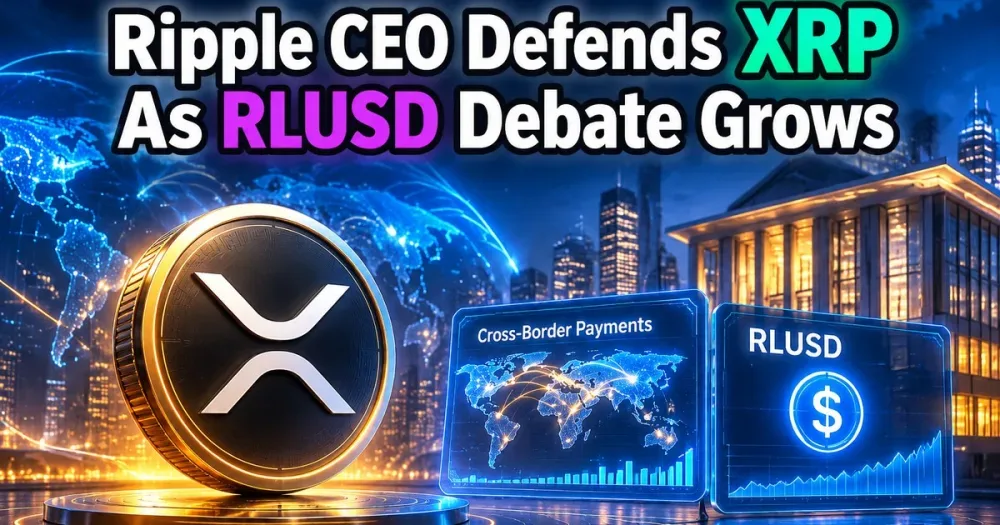
Ripple CEO Brad Garlinghouse defended XRP on Nov. 7, designating it the company’s “North Star” amidst holder accusations that Ripple is pivoting its attention toward RLUSD and alternative enterprise offerings. At the time, XRP was valued at $1.16, marking a 1.77% decline over 24 hours and sitting 66% lower than its all-time high from July 2025.
The core disagreement focuses on whether Ripple’s expanding business operations will generate actual demand for XRP, rather than whether the firm has completely walked away from the token. Garlinghouse maintains that Ripple will pursue strategies that advantage the digital asset, while conceding that traditional fiat or RLUSD may function better for specific transactions.
Ripple CEO Defends XRP After Renewed Community Criticism
The latest friction originated from a post by XRP commentator Fiduciary Ledger 17, who alleged that Ripple’s executive team was downplaying the economic relevance of XRP while scaling RLUSD and other enterprise products. The user noted that XRP holders stood by Ripple through regulatory challenges and its prolonged legal battle with the SEC, while advocating for a “fair value” target of $15 to $20 or higher.
That $15-to-$20 valuation represents the commentator’s personal target rather than an official Ripple projection or an independently verified assessment. Several accounts subsequently shared the criticism, highlighting an ongoing frustration: Ripple’s corporate growth has yet to translate into the elevated XRP demand or price action anticipated by certain holders.
Speaking at Swell 2026, Garlinghouse reiterated that XRP remains Ripple’s “North Star,” as reported by CryptoPotato. He stated that the firm aims to advance initiatives that support the asset, while recognizing that XRP will not be the ideal fit for every single transaction.
Holders continue to weigh Ripple’s institutional expansion against the practical utility and returns of XRP. Although the company has revealed partnerships with major financial institutions, those announcements do not establish that partners are required to use XRP or that their operational activity automatically generates token demand.
The critics also referenced Ripple’s historical regulatory struggles and SEC litigation as reasons why holders maintained their support for the firm. During Swell 2026, Garlinghouse repeated that Ripple intends to pursue avenues that aid XRP while allowing alternative payment methods where suitable, without modifying the token’s core function.
Schwartz’s Warning Adds to Public Tensions
While Garlinghouse serves as Ripple’s CEO, David Schwartz acts as its CTO Emeritus and a prominent figure within the XRP community. The primary critique regarding company priorities came from the X account Fiduciary Ledger 17.
In a separate statement, Schwartz announced plans to block numerous XRP accounts due to irrelevant replies and unsolicited promotions appearing on his X threads. He highlighted users posting insults, accusations, and unrelated XRP commentary within unrelated discussions, adding that he would also block accounts leveling allegations of fraud or scams against him.
U.Today reported on Schwartz’s warning as the broader controversy expanded beyond business models and pricing into public clashes between Ripple executives and community participants. Schwartz explained that the replies cluttered dialogues with other users, though he clarified he was not announcing any alterations to Ripple’s broader XRP strategy.
Schwartz added that these comments could trigger unwanted notifications for individuals tracking the unrelated threads where he was active. Detailing a trend of targeted XRP advertisements and personal attacks—including accusations of fraudulent behavior—he stated he would block accounts tracking him across X to make such assertions, regardless of whether they were framed positively or negatively.
His notice establishes personal boundaries for managing his account replies rather than addressing the economic anxieties of token holders. Schwartz outlined actions for his personal social media presence instead of introducing a formal corporate community policy or wider enforcement framework.
Ripple’s XRP Strategy Includes RLUSD and Other Products
Detractors point to RLUSD, treasury infrastructure, and institutional finance solutions that operate without necessarily utilizing XRP. Ripple has also publicized collaborations with prominent entities like Coinbase, Robinhood, BNY, and Standard Chartered. While these relationships demonstrate commercial engagement, they do not quantify the amount of demand produced for XRP.
Garlinghouse maintains that Ripple can address a broader financial market using XRP alongside stablecoins and traditional currencies, rather than forcing every enterprise product to incorporate XRP. Earlier in the year, he stated that “all roads lead back” to XRP. In another message, he argued that RLUSD avoids direct competition with XRP because the two instruments fulfill distinct functions.
Holders are looking for clarity on whether progress in payments, custody, stablecoins, and institutional services will translate into tangible utilization or demand for XRP.
Ripple’s architectural approach does not mandate token integration across every offering. Garlinghouse positions XRP as central to the company’s trajectory while permitting fiat or RLUSD when those instruments better suit a given transaction. The exact proportion of Ripple’s aggregate operations that will ultimately incorporate XRP remains uncertain.
The growth of RLUSD has emerged as a friction point, though it does not inherently indicate that Ripple has abandoned XRP. Garlinghouse asserts that the stablecoin occupies a separate purpose, whereas holders remain anxious that the expansion of non-XRP products might fail to benefit the token.
Business Update Put XRP Alongside Other Services
Ripple’s most recent business update outlines an objective to modernize financial architecture leveraging digital assets “such as XRP.” The framework incorporates payments, custody, stablecoins, treasury functions, and capital markets into this mission.
The corporate roadmap incorporates XRP alongside alternative products and services. Holders want to ascertain whether this vision will yield measurable demand for the asset, given that the company has not provided metrics detailing how much activity will route through XRP.
Ripple frames these offerings as interconnected components of financial infrastructure rather than services that depend on XRP for settlement. Explicitly mentioning digital assets “such as XRP” secures the token a defined place in the strategy, yet the update lacks any breakdown concerning transaction volumes, revenue shares, or product adoption tied directly to XRP.
Investors looking for proof of token utilization will require metrics beyond high-level strategic summaries. While payments and capital markets define the breadth of Ripple’s ambitions, they do not clarify which underlying assets customers will select or how frequently XRP will be utilized.
XRP Price and Market Figures Put the Dispute in Context
On Nov. 7, XRP traded at $1.16, accompanied by a market capitalization of approximately $73.78 billion and a 24-hour trading volume near $1.42 billion, based on CoinGecko statistics. The token dropped 1.77% over the preceding 24 hours.
| Metric | Figure |
|---|---|
| XRP price | $1.16 |
| 24-hour change | -1.77% |
| Market capitalization | ~$73.78 billion |
| 24-hour volume | ~$1.42 billion |
| Distance below July 2025 all-time high | 66% |
XRP remained 66% below its record high reached in July 2025. These metrics help clarify why holders are contrasting Ripple’s corporate growth with the token’s market valuation, as the two indicators have not moved in alignment.
The commentator’s call for a “fair value” between $15 and $20 represented an appeal for management to back higher market valuations rather than an official company price objective.
The gap between Ripple’s corporate momentum and the downward trajectory of XRP from its peak has stoked community discontent. Available metrics do not indicate that the deployment of RLUSD, corporate partnerships, or any single executive choice directly triggered the price movement.
The commentator provided no valuation framework or supporting evidence for the proposed “fair value,” framing the figure instead as an appeal for leadership to influence market outcomes.
Risks for XRP Holders as Ripple Expands RLUSD
Ripple’s ongoing product development may fail to generate increased XRP utilization or market demand. Since Garlinghouse notes that fiat currency and RLUSD can accommodate certain transactions, the firm’s broader market expansion does not guarantee that every offering will necessitate XRP.
The issue of trust is also prominent. If holders perceive that Ripple’s institutional alliances and stablecoin deployment primarily advantage assets other than XRP, discontent could escalate. Schwartz’s advisory regarding the blocking of disruptive accounts highlights how contentious public discourse has become.
The assertion that Ripple is intentionally diminishing the economic relevance of XRP remains an allegation leveled by commentators, as current disputes do not establish evidence of deliberate price suppression.
Ripple’s corporate update outlines multiple operational focus areas without detailing how usage volumes will be distributed among XRP, stablecoins, and fiat currencies. Lacking metrics that connect specific products or transaction flows directly to XRP, token holders cannot deduce underlying demand solely from the scope of company announcements.
Ripple has issued no new token-specific commitments, timelines, or performance goals in response to the backlash. Garlinghouse’s defense remains strategic: Ripple intends to pursue commercial opportunities that benefit XRP while competing within a larger financial landscape, leaving it unverified whether this approach will satisfy token holders.
What to Watch in Ripple’s Next Updates
Upcoming corporate updates and product announcements from Ripple will demonstrate how the organization balances XRP alongside payments, custody, stablecoin infrastructure, treasury, and capital markets. Rather than relying solely on partnership announcements, community members will monitor for concrete operational utilization and market demand for XRP.
Garlinghouse’s defense relies on Ripple’s capacity to scale a multi-product strategy while maintaining a prominent role for XRP. Meanwhile, Schwartz confirmed intentions to block accounts that flood unrelated X discussions with promotional XRP content, insults, or fraud claims. No specific timeline has been provided for alternative XRP-centric product launches or announcements.
Investors require detailed disclosures specifying where Ripple employs XRP and whether that utilization is scaling. While the latest corporate update identifies relevant business segments, it lacks XRP-specific activity metrics. Community calls for executive backing of higher valuations remain separate from any formal corporate commitments designed to achieve them.
Investors will continue tracking Ripple’s corporate communications and product rollouts, alongside any supplementary clarifications from Garlinghouse regarding the coexistence of XRP, RLUSD, and fiat alternatives. No schedules have been established for these disclosures. Presently, Ripple’s stated corporate stance continues to contrast with the community’s demand for quantifiable benefits directed at the token.
Separate XRP-Laundering Case Adds a Security Backdrop
A separate incident reported on Nov. 6 involved XRP compromised during the Binance security breach, distinct from Ripple’s commercial products or the community dispute. Between 20:05 and 20:09 UTC on Oct. 29, five hot wallets transferred 233.46 million XRP to an attacker-controlled address. Binance subsequently estimated the breach value at $6.34 billion, with the FBI attributing the operation to the North Korean threat group TraderTraitor.
According to Elliptic, approximately 42 million of the stolen XRP tokens—valued near $50 million—were converted primarily into bitcoin utilizing THORChain. Roughly 192 million XRP, representing about $226 million, remained unswapped within addresses tied to the theft.
The compromised XRP first shifted on Nov. 2, when approximately 233 million tokens migrated across six newly generated addresses between 02:12 and 04:00 UTC, remaining dormant until Nov. 5. That afternoon, two of the six wallets began routing XRP to dozens of new accounts to execute conversions, chiefly via THORChain into bitcoin, alongside minor quantities of ether processed that evening.
Elliptic noted that the primary bitcoin and ether holdings originating from the breach remained untouched. These asset transfers illustrate stolen XRP routing through cross-chain protocols amid an active criminal investigation; they do not reflect routine payment activity or market demand generated by Ripple’s commercial operations.
Binance reported freezing or intercepting roughly $2.85 billion while committing internal funds to absorb customer losses, with platform withdrawals reopening in phased stages. The money laundering inquiry spans over 20,000 wallets across 16 blockchains, at least 36 services, and no fewer than 65,000 transactions. Approximately $3.11 billion remains secured within addresses associated with the breach—primarily held as ether and bitcoin—with minimal funds successfully cashed out.
Unlike stablecoin issuers capable of freezing assets directly, XRP and bitcoin lack native mechanisms to freeze tokens in the same manner, the report observed. Following actions by Tether and Circle to lock down substantial stablecoin allocations on Oct. 29, the perpetrator migrated assets past those issuer-controlled frameworks. Subsequent XRP-to-bitcoin conversions adopted this evasion path while primary pools of bitcoin and ether remained undisturbed.
Bitcoin Magazine reported that the critical unresolved question is whether THORChain operators and alternative bridging protocols will maintain rapid blockades against published attacker addresses to slow ongoing conversions, or if additional portions of the remaining XRP will replicate the first tranche’s migration into bitcoin. This security investigation remains entirely separate from the holder dispute with Ripple, as the transfers concerned illicitly acquired assets rather than official corporate products or institutional partnerships.
FAQ
Who accused Ripple of reducing XRP’s importance?
XRP commentator Fiduciary Ledger 17 made the accusation in a post later reposted by other accounts. The post criticized Ripple’s emphasis on RLUSD and enterprise products.
What did Brad Garlinghouse call XRP at Swell 2026?
He called XRP Ripple’s “North Star” and said the company wants to pursue initiatives that benefit the asset. He also said XRP will not suit every transaction.
Does Ripple say XRP must be used in every transaction?
No. Garlinghouse said fiat or RLUSD may make more sense for some transactions, depending on the use case.
What is RLUSD in this dispute?
RLUSD is Ripple’s stablecoin. Its expansion has prompted some holders to worry that the company is prioritizing products that do not always require XRP. Garlinghouse says RLUSD serves a different purpose from XRP.
How far below its all-time high was XRP?
CryptoPotato described XRP as 66% below its July 2025 all-time high. On Nov. 7, XRP traded at $1.16.
Why did David Schwartz say he would block some XRP users?
Schwartz said irrelevant XRP promotions, insults and fraud accusations were disrupting unrelated conversations on X. He said the replies could also inconvenience other users following those conversations.
What will holders watch for in Ripple’s next updates?
They will look for evidence of practical XRP use and demand as Ripple expands its payments, custody, stablecoin, treasury and capital-markets businesses. Partnership announcements alone do not answer that question.
This article is for information only and is not financial advice.

Web3 PR Specialist | KOL | Blockchain Advocate | Digital Strategy Expert based in Moscow, Russia. Focused on Web3 communications, blockchain, digital strategy, and community growth.
More from this author
Comments 0 responses