
The First 1099-DA Filing Season: Why Your Form May Overstate Your Bitcoin Gains
Millions of Bitcoin users face the first Form 1099-DA filing season for the 2025 tax year. Because brokers report only gross proceeds without cost basis, transferred assets can make entire sales appear as taxable profit.

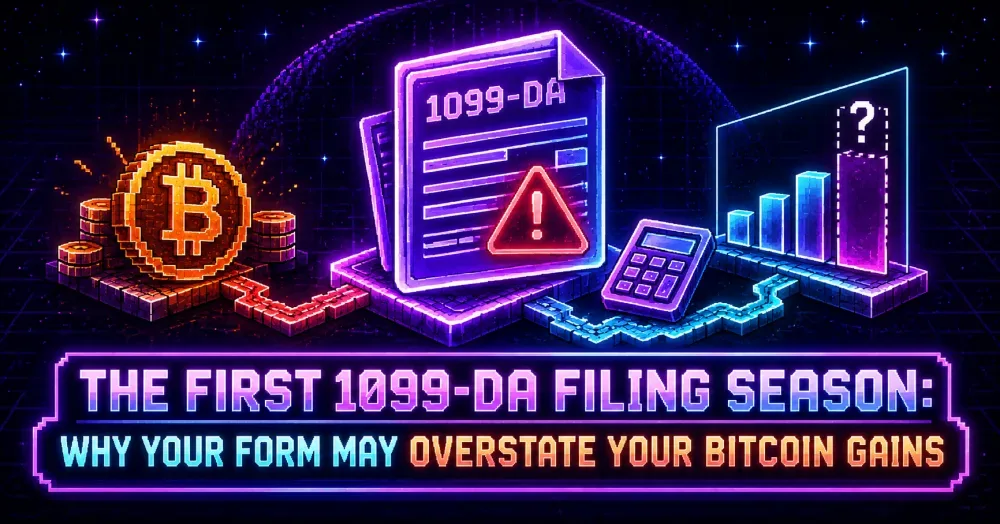
This spring, millions of Bitcoin users will encounter an unfamiliar piece of mail. Brokers are currently rolling out the first wave of Form 1099-DA—the IRS information return created for digital assets—which applies to sales beginning in the 2025 tax year.
Anyone who bought Bitcoin on one platform, transferred it to cold storage, and ultimately liquidated it elsewhere should carefully examine this document prior to filing taxes.
What the Form Actually Reports
Issued by a single broker, a 1099-DA reflects exclusively what that particular platform observed. For the 2025 tax year, brokers are required to report gross proceeds from sales. Cost basis reporting for covered assets does not commence until the 2026 tax year, and even then, it is restricted to assets acquired and maintained at that exact broker.
This creates a significant discrepancy, as gross proceeds do not equal gains. For instance, selling Bitcoin for $80,000 that was initially purchased for $65,000 results in a $15,000 taxable gain. However, the IRS may only receive documentation showing the full $80,000 proceeds. Bridging the gap between these figures is up to the taxpayer, often requiring records scattered across multiple wallets and platforms.
The Transferred-Bitcoin Problem
Long-term holders are particularly vulnerable to a specific scenario: purchasing Bitcoin years ago on one exchange, transferring it to a hardware wallet for safety, and later depositing it onto a different exchange to execute a sale. Because the selling broker never tracked the original purchase, the coins appear out of thin air and are simply converted into dollars.
Consequently, the 1099-DA may display a blank or zero cost basis, making the entire transaction look like 100% profit on paper. Filing taxes using these unadjusted figures risks overpaying on phantom gains, whereas claiming an unsupported basis triggers unwanted scrutiny. Addressing this requires reconstructing the full acquisition history—identifying purchase dates, acquisition costs, and the exact path the coins took across various wallets and exchanges.
One Portfolio, Several Forms
Active digital asset investors rarely rely on a single platform. Every broker generates an independent 1099-DA illustrating only the activity within its own ecosystem. Moving assets between personal accounts can resemble unexplained deposits and withdrawals until a unified timeline is established. As a result, two forms that are entirely accurate on their own can collectively present a misleading financial narrative for the year.
Because the IRS receives copies of every form issued, a tax return must reconcile all of them simultaneously. Every sale must be accounted for exactly once, and internal transfers must be correctly categorized as movements between personal wallets instead of taxable transactions.
Self-custody Is Still Your Job
The current iteration of 1099-DA reporting overlooks self-custody operations and decentralized protocols. Peer-to-peer sales, Lightning transactions, and on-chain swaps will not trigger any tax forms. Nevertheless, these activities remain fully reportable. Lacking a form has never excused anyone from tax obligations, and the digital asset inquiry remains positioned prominently at the top of Form 1040.
What a Clean Filing Looks Like
Achieving compliance involves a strict process: gathering every 1099-DA, compiling a consolidated transaction history across all wallets and exchanges, tracing transferred coins back to their original purchases, and generating a Form 8949 and Schedule D that align with the IRS’s records. Maintaining robust documentation is just as critical as the math, since a claimed basis requires verifiable records to back it up.
Holders managing years of transaction history, multiple platforms, or mismatched forms can utilize professional 1099-DA assistance to rebuild missing cost bases and supply compliant reports ready for a CPA or tax software.
The Bottom Line
While the 1099-DA is a recent development, the core tax laws remain unchanged. Taxes apply strictly to actual gains, not to the fragmented view witnessed by any single broker. The initial form received should be viewed as one piece of a broader financial puzzle rather than the definitive word, and taxpayers should never assume a zero in the basis column is accurate. For long-term Bitcoin investors, that zero is frequently the most costly figure on the document.
Frequently Asked Questions
What is Form 1099-DA?
Form 1099-DA is an IRS information return designed for reporting digital asset transactions, with brokers issuing the first wave of these forms starting for the 2025 tax year.
Why might my 1099-DA overstate my Bitcoin gains?
For tax year 2025, brokers only report gross proceeds, not your cost basis. If you transferred Bitcoin from cold storage to sell on an exchange that didn’t track your original purchase, the form may show a zero basis, making the entire sale look like pure profit.
Do I need to report Bitcoin transactions if I didn’t receive a 1099-DA?
Yes. Self-custody activity, peer-to-peer sales, on-chain swaps, and Lightning transactions do not generate 1099-DA forms, but they are still fully taxable and reportable.
How should I handle multiple 1099-DA forms from different platforms?
You must collect every form, build a unified transaction history across all your wallets and exchanges, ensure internal transfers are not treated as taxable events, and reconcile your tax return against every form the IRS receives.

Web3 PR Specialist | KOL | Blockchain Advocate | Digital Strategy Expert based in Moscow, Russia. Focused on Web3 communications, blockchain, digital strategy, and community growth.
More from this author


Comments 0 responses