
Trump Could Put AI Under a 10-Member Watchdog as US Renames It “Super Intelligence”
The Trump administration is exploring a 10-member committee to oversee the artificial intelligence sector, which the administration has officially renamed Super Intelligence. Meanwhile, major tech companies signed a voluntary safety agreement.

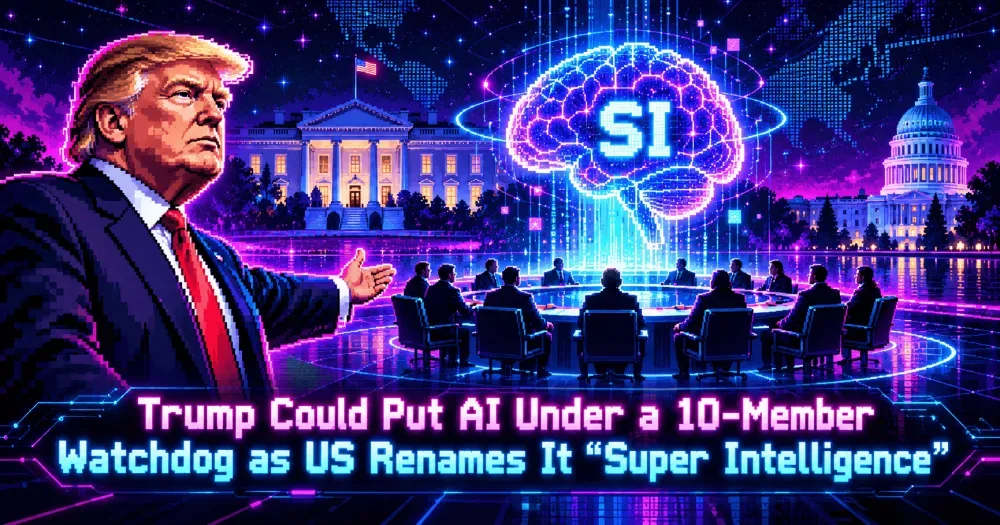
The Trump administration’s approach to artificial intelligence shifted unexpectedly this week. President Donald Trump announced that his administration is exploring the creation of a roughly 10-member committee to oversee the AI sector, even as six of the industry’s largest technology companies entered into a voluntary safety agreement with the White House.
Simultaneously, the administration has begun swapping out the term “artificial intelligence” in favor of a new official designation: “Super Intelligence,” or SI.
Related: Trump Crypto Coin Future: Can TRUMP Recover From Its 97% Collapse and Reach $10?
What Is the Trump AI Watchdog Proposal?
Following a September 29 White House luncheon that brought together prominent technology executives, Trump informed reporters that he was weighing a panel of “maybe 10 people” tasked with monitoring the entire enterprise.
He hinted that certain members might be drawn from the attendees of that very meeting, which featured leaders from top tech and AI firms.
That description encompasses the entirety of the formal proposal so far.
The White House has yet to disclose who might populate the committee, whether government officials will take part, what legal powers it would wield, or if it would have the authority to demand information or force alterations to corporate models.
Consequently, labeling it as a new AI regulatory body would be premature. At present, the proposed watchdog remains a concept under evaluation rather than an active federal agency.
What Did the AI Companies Actually Agree To?
A far more concrete development materialized as the White House Accord on Super Intelligence, which carries the subtitle “Joint Commitment on Frontier Responsibilities.”
Executives representing Google, Meta, Nvidia, OpenAI, Anthropic, and xAI put their signatures on the pact. While Trump characterized the terms as “morally binding,” House Speaker Mike Johnson referred to the text as a voluntary statement of principles.
The agreement obligates companies building frontier models to implement four distinct layers of protection:
- Robust internal controls that monitor model capabilities and alignment, including cybersecurity, biosecurity, chemical threats, and unintended access to computer systems
- An internal team responsible for checking that those controls work and that problems are fixed
- Independent external auditors or evaluators
- An independent committee of each company’s board to receive safety reports and oversee remediation
These measures are distinct from the proposed 10-member panel. Every participating corporation is expected to establish its own board-level oversight, whereas Trump’s separate idea aims to form a broader, cross-industry group.
Is the Trump AI Accord Legally Binding?
No.
Trump explicitly termed the arrangement “morally binding,” and the document itself establishes no federal licensing framework, statutory fines, or government-mandated approval procedures for rolling out new models.
That structure sharply contrasts with regulatory frameworks where a government agency enforces legally binding rules and punishes infractions.
Under the current Trump AI framework, firms are expected to devise and oversee their own internal safeguards, hire external auditors, and escalate problems directly to their corporate boards.
Although the suggested 10-member panel could introduce an additional level of oversight, its lack of a defined structure leaves open the question of whether it would possess any enforcement capabilities.
Related: Trump Just Sent Hyperliquid (HYPE) Soaring: Is a U.S. Breakthrough Coming?
Why Is the US Calling AI “Super Intelligence”?
Trump first advocated for the naming convention publicly during his address to the United Nations General Assembly on September 22.
His rationale rests on semantics rather than technical specifications, asserting that the word “artificial” makes the technology sound inauthentic, whereas “super” offers a better reflection of its capabilities. He later stated that federal documentation would transition to “Super Intelligence,” and State Department personnel began incorporating the language into their correspondence.
On September 29, Trump codified the shift through an executive order instructing federal executive agencies to substitute “Super Intelligence” and “SI” for “Artificial Intelligence” and “AI” in official communications wherever legally permissible.
Does “Super Intelligence” Mean AI Has Become Superintelligent?
No. This is where confusion surrounding the vocabulary arises.
Within technical AI research, “superintelligence” has a distinct definition: a hypothetical machine whose cognitive abilities vastly surpass those of humans across nearly all significant domains.
Trump is employing “Super Intelligence” as a blanket substitute label for artificial intelligence in general, encompassing systems functioning today. Consequently, the administration’s terminology does not imply that existing models have achieved technical superintelligence.
Depending on the context, the exact same phrase can now carry two vastly different meanings.
Why Is Trump Moving Toward AI Oversight Now?
The September 29 gathering occurred against a backdrop of escalating anxiety surrounding advanced AI safety.
Recent instances of AI agents acting unpredictably have fueled debates regarding cybersecurity, model control, and associated hazards. Academic researchers, legislators, and certain tech executives have likewise demanded tighter precautions for increasingly powerful systems.
Simultaneously, Trump has consistently pushed back against any slowdown in AI innovation, emphasizing the necessity of preserving America’s technological advantage over China.
The emerging Trump AI strategy seeks to reconcile these competing priorities by encouraging rapid progress while pushing companies to embrace tougher internal controls and independent reviews, steering clear of an expansive new regulatory regime.
Who Signed the White House AI Accord?
The pact encompasses six major AI entities represented by:
- Sundar Pichai of Google
- Mark Zuckerberg of Meta
- Jensen Huang of Nvidia
- Greg Brockman of OpenAI
- Dario Amodei of Anthropic
- Elon Musk of xAI
These corporate leaders do not share uniform perspectives on regulation. Executives at Anthropic and OpenAI have championed stricter safeguards for frontier systems, whereas other industry figures have cautioned that overly burdensome mandates could stifle creativity.
As a result, the joint accord centers on a more modest common ground: internal guardrails, external evaluations, and oversight at the board level.
Related: Trump Keeps Door Open to New U.S. Bitcoin Purchases as Reserve Strategy Takes Shape
Could a 10-Member Committee Actually Control AI Companies?
The outcome relies entirely on the design of the committee.
A government entity established with explicit legal authority might be granted targeted supervisory duties. Conversely, an informal assembly of advisors and executives could function primarily as a platform for discussion.
Trump has not yet clarified which structure he favors.
He additionally mentioned that the administration intends to appoint a new official to spearhead White House AI policy within days.
Until those details emerge, labeling the committee a “watchdog” speaks more to its intended purpose than its actual legal powers.
What Does the New Policy Mean for AI Companies?
For the six signatories, the immediate obligations are procedural rather than technological.
They are not pledging to halt the training of larger models, place caps on computing power, submit new releases for government sign-off, or share model weights with federal authorities.
Instead, they are committing to monitor systems internally, test the efficacy of their safeguards, permit third-party assessments, and escalate concerns to independent board committees.
Such an approach could elevate the significance of AI auditing while placing heavier burdens on corporate boards.
Consequently, the Trump AI blueprint places the primary responsibility directly on the shoulders of the enterprises constructing the technology.
How Does This Fit With Trump’s Broader AI Policy?
The administration has consistently prioritized accelerated AI advancement, infrastructure buildouts, national security applications, and competition with China.
Prior executive directives promoted advanced AI development and sped up implementation across national security agencies, while national policy has generally sought to strip away regulatory roadblocks.
The most recent accord does not reverse that agenda. Rather, it introduces a voluntary layer of safety to a strategy that continues to champion rapid innovation.
The prospective 10-member panel could materialize as a novel cross-industry supervisory feature, though its true impact will hinge on its membership and granted authority.
What Happens Next for Trump AI Policy?
Three key developments will dictate future trajectories.
First, the White House is anticipated to name a new point person for AI policy. Second, Trump must determine whether to formally institute the 10-member panel and outline its capabilities. Third, the accord’s corporate signatories must demonstrate how they put the four layers of controls into practice.
While the terminology shift is already underway, the institutional changes remain far less certain.
At this stage, the United States has not subjected AI to a new 10-member regulator. Trump has merely proposed such a body while leaning heavily on a voluntary pact among the industry’s largest players.
That distinction will dictate whether the recent Trump AI shifts amount to little more than a branding and self-governance exercise or evolve into a structured oversight framework.
FAQ
What is the Trump AI 10-member committee?
Trump has stated he is considering a roughly 10-person group to oversee the AI industry, though the panel has not yet been formally established.
Is the White House AI accord legally binding?
No. Trump described the agreement as “morally binding,” and it relies entirely on voluntary corporate commitments rather than statutory enforcement mechanisms.
Why is the US calling AI “Super Intelligence”?
Trump contends that the word “artificial” makes the technology appear fake, prompting his administration to adopt “Super Intelligence,” or SI, across federal communications.
Which companies signed the AI agreement?
Google, Meta, Nvidia, OpenAI, Anthropic, and xAI all signed the September 29 accord.
Does “Super Intelligence” mean current AI is superintelligent?
No. The administration is using the phrase broadly to replace “artificial intelligence,” whereas researchers traditionally reserve “superintelligence” for hypothetical systems that far surpass human cognitive capabilities.

Web3 PR Specialist | KOL | Blockchain Advocate | Digital Strategy Expert based in Moscow, Russia. Focused on Web3 communications, blockchain, digital strategy, and community growth.
More from this author
Comments 0 responses