
What Is Elysium Crypto? Kinetiq’s Hyperliquid Network and Uniswap Launch
Kinetiq rolled out the public mainnet for Elysium on Hyperliquid, featuring fast block times and integration with Uniswap protocols. The network uses HYPE for gas and allocates sequencer revenue for KNTQ buybacks and builder incentives.

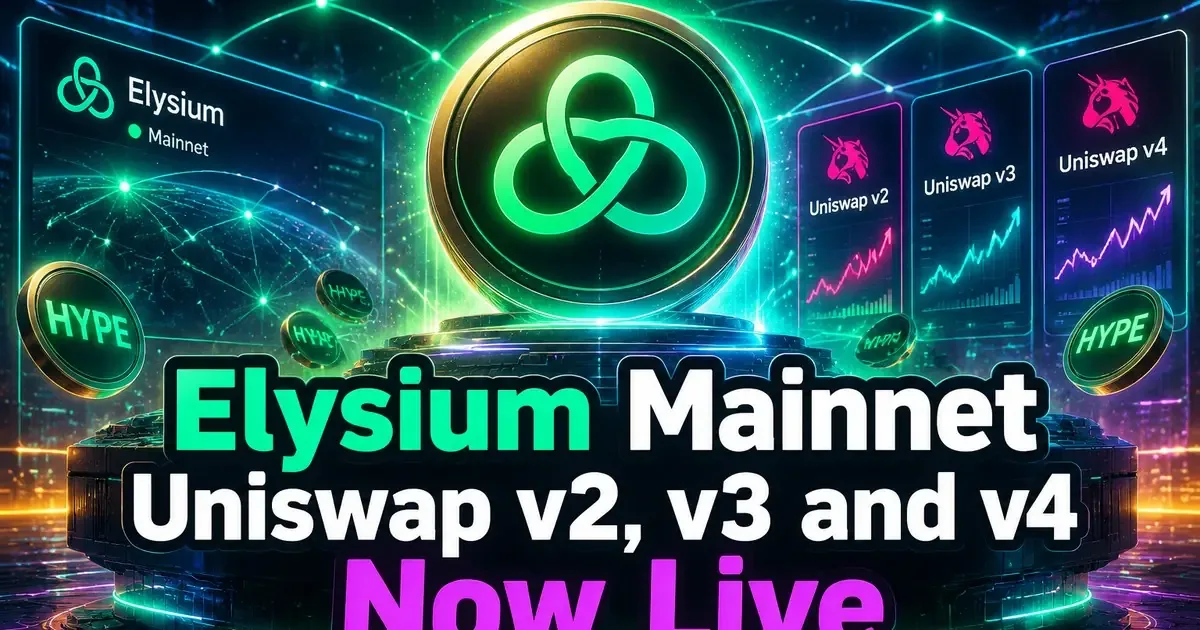
Kinetiq rolled out Elysium’s public mainnet for Hyperliquid on November 9, 2026, highlighting a block time of 100 milliseconds. Two days later, Uniswap confirmed that its v2, v3, and v4 protocols were operational on the network, integrating a major decentralized trading protocol into Kinetiq’s latest environment.
Per crypto.news launch reports, Elysium settles to HyperEVM and utilizes HYPE for transaction fees. Additionally, Kinetiq has pledged a portion of network sequencer revenue toward KNTQ buybacks and builder incentives. These represent core network developments, whereas a separately tracked Ethereum token bearing the name Elysium is not an officially recognized Kinetiq asset.
What Is Elysium Crypto? The Network Behind the November Launch
What did Kinetiq launch on November 9?
Developed by Kinetiq for the Hyperliquid ecosystem, Elysium is structured using Arbitrum technology, utilizing Conduit for infrastructure and HyperEVM as its settlement layer. Kinetiq has designated spot trading, lending, derivatives, structured products, and token launches as its primary use cases.
Announced performance metrics cite 100-millisecond blocks alongside an execution capability of 300 million gas units per second. These figures reflect project targets rather than independently verified transaction throughput or finality guarantees.
Which tokens have defined roles?
HYPE functions as the network gas token, requiring users to pay transaction fees in HYPE. Meanwhile, KNTQ is Kinetiq’s native token tied to the sequencer revenue buyback program. Elysium designates the network itself rather than an official token ticker designated in the launch coverage.
As reported by Crypto Economy, the network economic design lacks a standalone governance token or independent emissions. Distinguishing these roles is vital when evaluating market listings utilizing the Elysium name.
Who Built Elysium and How Does It Connect to Hyperliquid?
What roles do Kinetiq, Conduit and HyperEVM play?
While Kinetiq engineered Elysium, Conduit supplies the necessary infrastructure and HyperEVM acts as the settlement layer. Although Elysium and HyperEVM maintain a close relationship, they operate as distinct network entities; a deployment on Elysium should not be regarded as one directly on HyperEVM.
Kinetiq positioned the network as a destination for applications linked to the Hyperliquid ecosystem. Its intended functions cover various financial applications, while the integration of HYPE aligns transaction fees directly with the broader Hyperliquid environment.
How did Elysium move from plans to mainnet?
Initial plans were introduced by Kinetiq in August, featuring proposals to route sequencer fees into token acquisitions and application developers. The public mainnet debut followed on November 9, with Uniswap’s deployment announcement going live on November 11 to provide builders with an active protocol environment.
Uniswap documentation associates Elysium with chain ID 99901, while assigning chain ID 999 to HyperEVM. Deployment registries further separate the networks via unique v4 PoolManager entries, offering a crucial distinction for developers building applications.
How Elysium Uses HYPE and Allocates Network Revenue
How does HYPE work across the two networks?
Kinetiq states that HYPE moves between HyperEVM and Elysium at a 1:1 ratio, acting as native gas on Elysium without requiring an intermediary wrapper token. Furthermore, HyperEVM ERC-20 assets can transition to Elysium permissionlessly.
This framework establishes a native transaction-fee asset from day one. While source reports detail the transfer mechanism, they do not include verified bridge volume figures or user metrics.
How are sequencer fees divided?
Kinetiq has earmarked 50% of sequencer revenue for KNTQ buybacks, with another 25% designated for builders whose applications drive demand for Elysium blockspace. These figures represent planned allocations rather than confirmation that buybacks or builder payouts have already executed.
These specified percentages account for 75% of total sequencer revenue, leaving the final quarter unallocated in Kinetiq’s current statements.
What can builder funding support?
Eligible teams can channel their allocated share into user rewards, liquidity initiatives, fee rebates, or other application-level mechanics, according to Kinetiq. The targeted applications span spot markets, lending, derivatives, structured products, and token launches.
Consequently, builder funding depends entirely on applications successfully driving blockspace demand. The framework outlines an intended distribution model rather than an active list of funded projects.
The Ethereum Elysium Listing: Price Data and Identity Limits
What does the Ethereum market listing show?
A DEX Screener market record from November 12, 2026, at 15:22 UTC details an Ethereum token named Elysium. It displays a price of $0.0001099, market capitalization and fully diluted valuation metrics of $109,900 each, and a 24-hour trading volume of $1.03.
These metrics apply exclusively to that Ethereum listing and do not reflect Kinetiq’s network, HYPE, or KNTQ. The market entry shows no proven connection to the mainnet rollout or Kinetiq.
When did its tracked pair begin trading?
The recorded Uniswap trading pair, paired against ETH, was created on November 11, 2026, at 18:40 UTC, serving as the sole pair in that market entry. Pair creation timestamps indicate when a trading pair appeared, not when an official token deployment occurred or whether a project endorses it.
Why do matching names need care?
Market records feature multiple tokens using the Elysium name across Solana, Robinhood, and an alternate chain labeled Elysium. The tracked Ethereum listing lacks an official project website or social links, pointing to a broader ticker collision. Sharing a name does not confirm an issuer’s identity or operational affiliation.
An older, unrelated project—a Vulcan Forged gaming and metaverse blockchain covered in an October 2021 Egamers.io article utilizing PYR and LAVA tokens—also bears the Elysium name and predates Kinetiq’s 2026 network.
Why Elysium Is in the News: Uniswap Goes Live
What did Uniswap announce?
Uniswap’s official channels announced on November 11 that v2, v3, and v4 protocols were live on Elysium, directing developers to dedicated deployment documentation containing network-specific contracts.
Uniswap v2, v3, and v4 are live on Elysium
Builders can find official deployment addresses in our developer docshttps://t.co/8fFClmhwxX
— Uniswap (@Uniswap) November 11, 2026
What is included in the deployment?
The release encompasses a v2 factory and router; a v3 factory, quoting utilities, and position manager; and a v4 suite featuring the PoolManager, PositionManager, Quoter, StateView, and Universal Router. Uniswap’s v3 deployment guidelines advise developers to verify network-specific address mappings rather than assuming uniformity across chains.
While this expands available tools for builders on Elysium, the deployment does not act as an endorsement or verification of every token or application trading within the network.
What other integration was reported?
Coinfomania highlighted an integration with the Jupiter Bridge Aggregator to facilitate asset transfers between Solana and Elysium. While the connection enables cross-network asset movement, it lacks published transfer volumes or confirmed user growth metrics.
What the Announcements Establish About Elysium’s Identity
What is directly supported about the deployment?
Uniswap’s official statements confirm that its three protocol variants are live on Elysium, backed by developer documentation outlining network-specific data. Meanwhile, Kinetiq’s launch updates clarify the network’s connection to Hyperliquid, HYPE gas, and HyperEVM settlement.
These announcements validate specific technical network integrations without implying that every token utilizing the Elysium name is issued or backed by Kinetiq.
What risks apply to the tracked Ethereum token?
The Ethereum trading pair features low liquidity under $100,000, lacks an official website in its record, and shares a name with concurrent assets across other chains. These factors emphasize the need for careful token identification.
Additionally, the recorded 24-hour volume of $1.03 is negligible. These metrics pertain solely to the listed token pair and do not evaluate the security of Kinetiq’s network, its cross-chain bridge, or the Uniswap deployment.
Where to Verify Elysium Deployments and Trading Listings
Where should builders check Uniswap deployments?
Uniswap’s November 11 notice points developers to its core documentation. Its deployment registries categorize v2, v3, and v4 entries by network, with v3 guidelines explicitly warning against cross-chain address assumptions.
For Elysium, documentation assigns chain ID 99901, distinguishing it from HyperEVM’s chain ID 999. Distinct v4 PoolManager parameters underscore the necessity of verifying network selection during application integration.
Where is the tracked Ethereum pair listed?
The market entry points to a DEX Screener page tracking a Uniswap pair on Ethereum using ETH as the quote asset. This page serves solely as a source for market metrics rather than an official Kinetiq purchasing channel or proof of mainnet project affiliation.
Users evaluating assets should always cross-reference project documentation and networks rather than relying strictly on names found via token searches. Reported market listings remain entirely separate from the HYPE gas and KNTQ buyback frameworks outlined in official network coverage.
How Elysium’s Execution and Uniswap Features Compare
What performance targets did Kinetiq announce?
Kinetiq’s release metrics specify a 100-millisecond block time target alongside an execution goal of 300 million gas units per second. These figures represent structural design goals rather than measured transactions-per-second outcomes or finality guarantees.
The network supports unmodified Solidity and Vyper contracts, accommodating development environments like Foundry, Hardhat, viem, and ethers to ease developer onboarding.
What distinguishes Uniswap v3 and v4 on the network?
Under v3, liquidity providers select specific price ranges for their positions. Positions stop accruing fees when market prices move outside their configured range, and token balances adjust dynamically with price action.
V4 maintains concentrated liquidity while routing pool operations through a unified PoolManager framework and incorporating optional hooks. Developers can utilize hooks to implement custom behaviors—such as dynamic fee structures—around swaps and liquidity adjustments.
Integrating these protocols brings advanced trading tools to Elysium, though real-world utility depends on actual application adoption and liquidity generation rather than the deployment announcement alone.
Elysium FAQ: Launch, Network and Builder Allocations
Which network does Elysium settle to?
Kinetiq’s launch documentation indicates that Elysium settles to HyperEVM, while operating as a standalone network with dedicated deployment guidelines.
What chain ID does Uniswap list for Elysium?
Uniswap designates chain ID 99901 for its Elysium deployments, whereas HyperEVM is listed separately under chain ID 999.
When did Elysium’s public mainnet launch?
The public mainnet for Elysium went live on November 9, 2026, followed by Uniswap’s v2, v3, and v4 protocol launch announcements on November 11.
What is Elysium’s announced block time?
Kinetiq specified a design target block time of 100 milliseconds, alongside an execution benchmark of 300 million gas units per second.
Which token pays Elysium transaction fees?
HYPE operates as the native gas token for transaction fees on Elysium, while KNTQ serves a separate role in Kinetiq’s revenue allocation model.
How much sequencer revenue is committed to KNTQ buybacks?
Kinetiq has allocated 50% of its sequencer revenue toward KNTQ buybacks, structured as an intended commitment rather than historical purchase data.
How much is allocated to builders?
An additional 25% is earmarked for builders whose applications drive blockspace demand on Elysium. Kinetiq notes that teams can deploy these funds toward user incentives, liquidity provisioning, or fee rebates.
FAQ
Which network does Elysium settle to?
Kinetiq’s launch documentation indicates that Elysium settles to HyperEVM, while operating as a standalone network with dedicated deployment guidelines.
What chain ID does Uniswap list for Elysium?
Uniswap designates chain ID 99901 for its Elysium deployments, whereas HyperEVM is listed separately under chain ID 999.
When did Elysium’s public mainnet launch?
The public mainnet for Elysium went live on November 9, 2026, followed by Uniswap’s v2, v3, and v4 protocol launch announcements on November 11.
What is Elysium’s announced block time?
Kinetiq specified a design target block time of 100 milliseconds, alongside an execution benchmark of 300 million gas units per second.
Which token pays Elysium transaction fees?
HYPE operates as the native gas token for transaction fees on Elysium, while KNTQ serves a separate role in Kinetiq’s revenue allocation model.
How much sequencer revenue is committed to KNTQ buybacks?
Kinetiq has allocated 50% of its sequencer revenue toward KNTQ buybacks, structured as an intended commitment rather than historical purchase data.
How much is allocated to builders?
An additional 25% is earmarked for builders whose applications drive blockspace demand on Elysium. Kinetiq notes that teams can deploy these funds toward user incentives, liquidity provisioning, or fee rebates.
This article is for information only and is not financial advice.

Web3 PR Specialist | KOL | Blockchain Advocate | Digital Strategy Expert based in Moscow, Russia. Focused on Web3 communications, blockchain, digital strategy, and community growth.
More from this author

Comments 0 responses