
XRP’s 2029 Outlook Pits Large-Wallet Growth Against ETF Outflows
XRP three-year price prediction to 2029 weighs growing large-wallet participation against ETF outflows, with lending adoption key to lasting demand. The post XRP’s 2029 Outlook Pits Large-Wallet Growth Against ETF Outflows appeared first on Bitcoin Foundation.

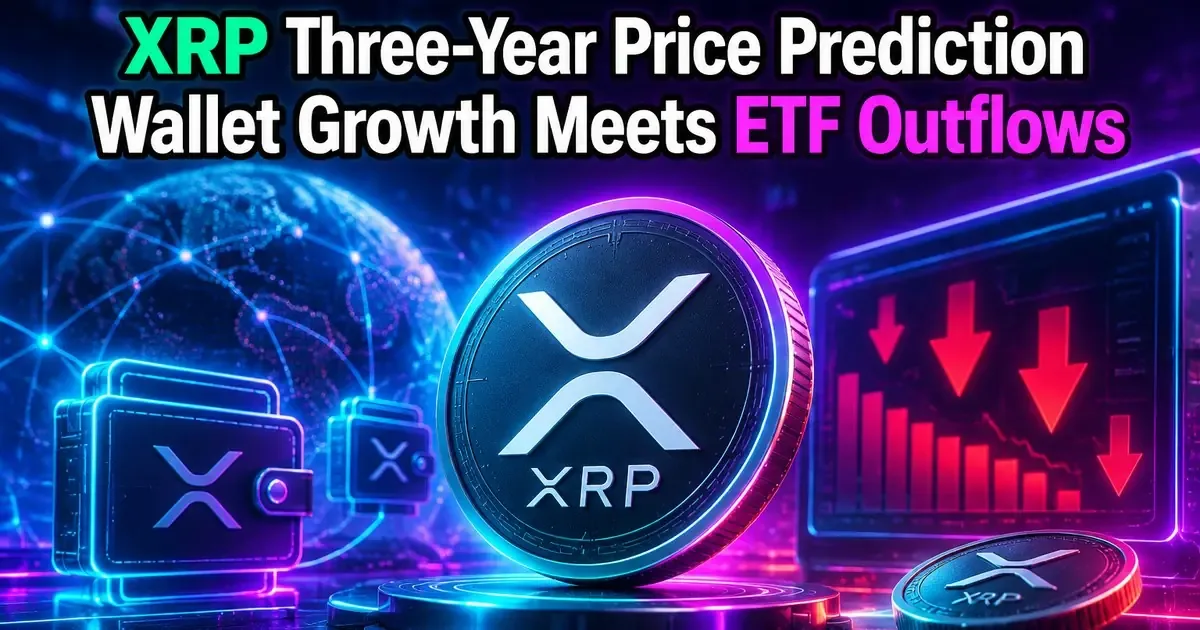
On November 12, 2026, XRP changed hands at $1.036, reflecting a 24-hour decline of 1.66% according to CoinGecko data. The outlook for XRP over the three-year period leading to November 2029 depends on whether expanding large-wallet holdings and planned institutional lending features can offset ongoing ETF withdrawals and persistent selling near the $1 mark.
The immediate market divergence is evident: addresses holding substantial XRP balances have grown, whereas U.S. spot funds have experienced capital outflows. The long-term trajectory will be determined by whether these accumulating buyers and incoming XRP Ledger capabilities can maintain demand throughout the upcoming market cycle.
XRP’s Three-Year Outlook Starts With the XRP Ledger
Which Asset Does This XRP Prediction Cover?
This assessment focuses exclusively on XRP, the native cryptocurrency of the XRP Ledger. Official documentation describes it as a digital asset designed for payments in 2012 and actively traded on open markets.
Read More: XRP Lending Needs Seven More Votes as Token Slips to $1.04
Distinguishing this asset is critical, as other networks like Solana and Polygon feature tokens using the XRP ticker or the Ripple name. The native asset’s role in payments, validator governance, and network updates forms the bedrock of this forecast; duplicate tickers on alternative blockchains require independent authentication.
Why Does the Forecast Extend to November 2029?
This three-year horizon spans from November 2026 to November 2029. It also aligns with analyst ChartNerd’s hypothesis that XRP’s next cyclical peak could materialize in 2029, a projection derived from historical time gaps of approximately 1,400 to 1,440 days between previous market tops.
This is a scheduling hypothesis rather than a definitive valuation formula. The evaluations below explore the catalysts that could strengthen or undermine XRP across this timeframe, using current price action as short-term milestones.
Ripple and XRPL Development Put Lending in Focus
How Are Ripple, the Network and XRP Connected?
Ripple operates as the enterprise, the XRP Ledger functions as the decentralized network, and XRP serves as the native coin. Historical documentation shows that the network’s founders originally allocated 80 billion XRP to Ripple, binding the company’s financial ecosystem to the digital asset from its inception.
David Schwartz, former chief technology officer at Ripple, was instrumental in developing the XRPL. His involvement highlights the ties between the corporate entity and the ledger, though any proposed protocol modifications still require explicit approval from independent validators.
How Far Has the Lending Proposal Advanced?
The proposed institutional lending protocol has secured backing from 22 out of 35 validators, advancing from 19 approvals recorded a month prior. A related amendment, SingleAssetVault, currently holds 23 votes, while the core lending amendment requires 29 validator votes to clear activation hurdles.
For the multi-year outlook, the key test lies in translating this expanding validator support into a functional service. While validator momentum indicates technical progress, subsequent institutional participation will provide a measurable indicator of adoption.
What Is Scheduled for November 25?
Developers are scheduled to reset the XRPL Testnet and Devnet on November 25 to resolve infrastructure challenges and enhance stability for full-history servers. This reset will wipe existing test accounts, balances, transaction histories, tokens, automated market makers, escrows, and all associated on-chain test data.
This action is restricted to testing infrastructure, leaving the mainnet untouched. Its significance to the forecast is operational, showcasing ongoing engineering efforts to maintain the environments utilized for building and testing network applications.
XRP Payment Utility and Ripple’s Broader Business
What Uses Underpin the XRP Adoption Thesis?
The XRPL overview characterizes XRP as a currency bridge, a utility asset for cross-border transactions, and a tool for micro-payments. It also facilitates traders moving collateral between exchanges and managing trading inventories efficiently.
These functions provide long-term forecasters with concrete use cases to evaluate. A successful adoption path requires payment and trading volumes to evolve into steady sources of demand, running parallel to pure investment accumulation.
What Would Institutional Lending Add?
The proposed framework would introduce fixed-term, uncollateralized lending capabilities tailored for institutions like banks and financial payment processors, with risk management and underwriting executed off-chain.
This design expands the ledger’s financial utility beyond basic transfers. Its impact on a 2029 outlook hinges upon its eventual activation, real-world utilization, and the specific role assigned to XRP within those financial workflows.
How Does Ripple Payments Fit Into the Forecast?
Ripple’s product documentation highlights payment infrastructure spanning over 60 markets with settlement options across 17 fiat currencies alongside prominent stablecoins. The platform allows users to receive, hold, convert, and disburse funds through a unified interface.
Because these services heavily feature fiat and stablecoin rails—often handling stablecoin conversions quietly in the background—investors analyzing XRP adoption must separate general company expansion from direct, XRP-specific payment activity.
XRP Price and Market Size Put $1 at the Center
Where Did XRP Trade on November 12?
At 12:36:59 UTC on November 12, XRP held the sixth position globally by market capitalization. Its intraday losses brought the token close to the psychologically significant $1 threshold monitored closely by market participants.
| Metric | XRP |
|---|---|
| Price | $1.036 |
| 24-hour change | -1.66% |
| Market capitalization | $65.77 billion |
| 24-hour trading volume | $1.50 billion |
| Fully diluted valuation | $103.54 billion |
This substantial market capitalization establishes a large foundational baseline for the forecast. Valuation projections through 2029 will ultimately depend on shifts in circulating supply and sustained demand, interacting alongside broader macroeconomic conditions.
Which Levels Matter in November 2026?
Analytics firm Santiment designates $1 as the critical support level that bulls must defend. Their conditional recovery models point toward a potential push to $1.10–$1.15 should large-wallet accumulation persist and Bitcoin stabilize.
Conversely, a sustained drop beneath $1 paired with cooling wallet expansion could trigger a short-lived selloff, potentially paving the way for a recovery following retail capitulation. These technical boundaries define immediate trading conditions, whereas the three-year outlook relies on structural shifts in network participation and utility.
XRP Wallet Growth Meets ETF Withdrawals
Who Has Been Adding XRP Exposure?
Data cited by BeInCrypto from Santiment indicates that approximately 344,000 wallets hold a minimum of 10,000 XRP, reflecting an increase of 16,815 wallets—or 5.15%—since February 9.
Additional tracking reveals that whale entities accumulated over 65 million XRP over a four-day window. Earlier during the market pullback, another tier of large holders scooped up 16.5 million XRP as prices dipped from $1.34 to $1.15.
These acquisitions represent the constructive elements of the current market structure. Consistent buying pressure during periods of price weakness reinforces the thesis that large-scale participants are willing to absorb excess supply.
Where Is Selling Pressure Coming From?
Figures from SoSoValue show that U.S. spot XRP exchange-traded funds registered $10.42 million in net outflows on November 9, followed by an additional $7.62 million on November 10. The November 9 withdrawal marked the highest single-day capital flight since March 9.
Furthermore, Binance cumulative volume metrics hovered near negative 4.33 million XRP, demonstrating that aggressive selling outpaced buying activity within that order book. Persistent ETF withdrawals and exchange selling make price recovery challenging, even amidst accumulation by large individual wallets.
How Has Borrowed Exposure Changed?
Analyst Arab Chain noted that XRP’s estimated leverage ratio on Binance dropped to roughly 0.14, hitting a three-month low. Binance open interest for XRP settled at $189 million on November 11, remaining near the $182 million level logged on August 2.
Arab Chain observed that lower leverage mitigates the threat of systemic liquidation cascades, though overall liquidity and price trends still dictate risk parameters. A less leveraged marketplace places the burden of price action squarely on direct spot demand.
XRP’s 2029 Paths Depend on Participation and Execution
What Supports the Bullish Scenario?
Within a bullish framework, large-wallet accumulation continues unabated, ETF fund flows turn positive, and the proposed institutional lending mechanism matures into an actively utilized financial tool. Concurrently, broader payment and trading applications would validate the network’s investment thesis.
On-chain activity offers another metric to monitor. XRPScan data captured roughly 41,700 unique active senders, exceeding the 30-day average of 29,300, pointing to rising network engagement as reported by U.Today.
For this network activity to reinforce a bullish outlook, it must endure alongside consistent capital inflows and practical deployments. Technical models highlight higher local price highs and steady buying as key recovery signals.
What Would a Middle Path Look Like?
In a moderate scenario, network development progresses steadily while investment demand experiences periods of volatility. Large wallets maintain their positions, but ongoing ETF outflows and exchange selling periodically counteract their buying efforts.
This middle-ground path leaves XRP balancing technological advances in financial applications against mixed market sentiment. Investors would need to weigh the actual speed of adoption and the consistency of fund flows as the November 2029 milestone approaches.
What Would Strengthen the Bearish Scenario?
Under a bearish trajectory, selling pressure persists, large-wallet expansion stalls, and proposed financial services struggle to attract institutional participation. A decisive breakdown below the $1 support level under these conditions would intensify the immediate downward pressures highlighted by Santiment.
For historical context, peak unique sender activity reached 106,000, dwarfing recent metrics. A long-term negative outlook would feature deteriorating network participation, declining overall demand, and a failure to successfully execute the platform’s financial service ambitions.
XRP Forecast Risks Include Supply and Asset Confusion
Why Is a Matching XRP Ticker a Risk?
The existence of tokens bearing the XRP and Ripple names on alternative chains like Solana and Polygon presents a tangible risk of misidentifying the asset. True native XRP exists exclusively on the XRP Ledger, requiring users to verify network origins before executing transactions.
Consulting official XRPL documentation serves as a reliable identity check. A token’s name alone cannot verify its association with native XRP, meaning alternative network listings require independent risk vetting.
What Supply History Matters Through 2029?
The XRPL overview confirms that the entire supply of XRP has already been minted, with a hard cap ensuring no more than the original 100 billion tokens can ever exist. It also highlights Ripple’s historical structure, which locked 55 billion XRP into ledger-controlled escrow accounts.
This foundational escrow schedule forms a vital component of XRP’s supply dynamics. Any long-term valuation model must account for shifts in circulating availability as well as demand, placing supply metrics on equal footing with network upgrades.
How Should Readers Interpret Schwartz’s Reduced Holdings?
David Schwartz publicly disclosed that he reduced his personal XRP holdings from approximately 26 million tokens down to 3 million, noting he has not purchased additional XRP in years. He explained that he maintains a high level of risk aversion and tailored his portfolio allocation to fit his personal tolerance for financial exposure.
His statements drew criticism from segments of the holder community given his foundational role in creating the XRPL. However, they also underscore fundamental investment realities: an individual intimately familiar with a technology can believe in its long-term viability while choosing a smaller personal financial exposure.
Checking XRP Listings and Its Payment-Market Position
Where Is XRP Listed?
Legitimate exchanges supporting native XRP include Binance, Coinbase Exchange, KuCoin, and OKX. Traders must verify that the asset and its underlying network align with official XRPL guidelines when evaluating market listings.
This verification step is especially critical when search queries surface tokens sharing the XRP moniker on foreign blockchains. The asset evaluated throughout this outlook remains exclusively the ledger-native cryptocurrency.
How Does XRP Compare With Bitcoin, Ethereum and Stablecoins?
During the previously cited four-day accumulation phase, large-scale holders of Bitcoin and Ethereum were shedding tokens while XRP whales expanded their balances. This divergence sets XRP-apart in terms of localized accumulation trends, with future capital flows acting as upcoming tests.
Payment positioning presents a different contrast. While XRP operates as a bridging instrument within the XRPL architecture, Ripple markets distinct fiat and stablecoin infrastructure; the most robust adoption narrative through 2029 would feature definitive proof of XRP carving out its own utility as these ecosystems grow.
FAQ
What Date Anchors This XRP Forecast’s November 2029 Horizon?
The baseline analysis begins on November 12, 2026. November 2029 marks the designated three-year evaluation endpoint, coinciding with analyst ChartNerd’s identification of 2029 as a potential cycle peak year.
When Is the XRP Ledger Testnet and Devnet Reset Scheduled?
The infrastructure reset is slated for November 25, 2026. This maintenance event is strictly confined to the two testing networks and leaves the production XRP Ledger entirely unaffected.
What Must Developers Recreate After the Test-Network Reset?
Developers must rebuild their testing accounts and request fresh allocations of test XRP. All legacy balances and transaction histories resident on the test networks will be permanently purged during the November 25 reset.
What Validator Support Does the Proposed XRPL Lending Amendment Need for Activation?
The proposed amendment requires consistent support from 29 validators for a duration of two consecutive weeks. Current tracking shows support from 22 out of 35 validators, with the companion SingleAssetVault proposal holding 23 votes.
How Quickly Can XRP Transactions Settle on the XRP Ledger?
Official documentation specifies an average settlement window of three to five seconds. The ledger facilitates direct peer-to-peer transfers without central intermediaries alongside native cross-currency bridging.
What Balance Qualifies a Wallet for the Reported XRP Shark-Wallet Cohort?
An address must hold a minimum of 10,000 XRP to qualify. Santiment tracking identified 343,500 such wallets, marking a 5.15% expansion since February 9.
How Negative Was XRP’s Reported Retail Sentiment?
Santiment tracked 0.49 bullish comments for every bearish remark. This ratio indicates that negative commentary doubled positive discussion while the token endured downward price pressure.
This article is for information only and is not financial advice.

Web3 PR Specialist | KOL | Blockchain Advocate | Digital Strategy Expert based in Moscow, Russia. Focused on Web3 communications, blockchain, digital strategy, and community growth.
More from this author
Comments 0 responses