
NextBlock invests $3M in Soda Labs to expand blockchain privacy
NextBlock has invested $3 million in Soda Labs' seed round to help scale its blockchain privacy infrastructure, advance financial integrations, and expand the Soda Bubble network across major platforms.

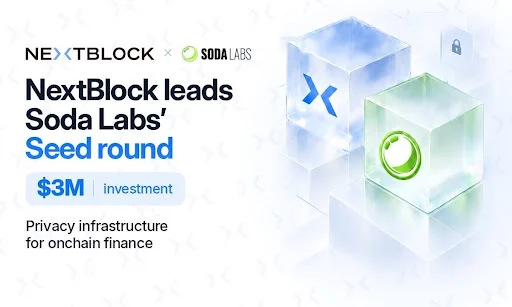
- NextBlock backs Soda Labs’ seed round with a $3 million investment.
- Soda Labs scales its privacy infrastructure across leading blockchain networks.
- The firm aims to broaden adoption, grow its validator network, and advance financial integrations.
NextBlock has poured $3 million into Soda Labs’ seed round, fully backing the closed funding round to help the blockchain infrastructure developer scale its programmable privacy solutions for public blockchain financial transactions.
This financial injection arrives as Soda Labs transitions from its current gcEVM privacy layer to Soda Bubble—a chain-agnostic coprocessor engineered to support private computations across various blockchain platforms.
Over the past two and a half years, Soda Labs has focused on building a cryptographic privacy framework utilizing garbled circuits and multiparty computation (GC-MPC).
The firm notes that its system leverages standard cryptographic protocols like AES and SHA256, running smoothly on conventional cloud CPUs without the necessity of specialized hardware.
“What attracted us to Soda was not only the underlying cryptography, but the practicality of the technology for the financial workloads we believe will matter most onchain,” remarked Pieter van Poecke, Founder and General Partner at NextBlock.
Van Poecke pointed out that Soda already featured a functioning product alongside paying customers, while its technical intellectual property, founding technical team, and commercial capabilities laid a solid groundwork for its upcoming growth phase.
Soda Labs expands privacy infrastructure
Soda’s technology has successfully handled over 100 million transactions on the COTI network. Its deployed integrations feature the perpetuals exchange PriveX and the tokenisation platform Zoniqx.
According to the company, PriveX has facilitated more than $20 billion in trading volume, while Zoniqx actively brings on board issuers spanning multiple asset classes and jurisdictions.
While Soda’s legacy gcEVM privacy layer remains operational on COTI, the company is actively scaling its framework via Soda Bubble. This new architecture is built to handle developer-defined workloads across disparate blockchains without leaking private information publicly or to Soda Labs itself.
Through the Bubble Validator Network, participants can mathematically verify that computations dependent on private data were executed accurately.
Soda Labs is currently rolling out Bubble across prominent EVM ecosystems such as Ethereum, Polygon, Base, and Arbitrum, while also laying groundwork for non-EVM network integration, including Solana.
Company targets commercial adoption
The fresh capital provides Soda Labs with the runway to prioritize scaling commercial adoption and execution throughout the next 12 to 18 months.
The business intends to allocate the funds toward its go-to-market initiatives, expanding its validator network, extending blockchain coverage, growing its team, and building integrations with payment firms, banks, tokenisation platforms, and alternative financial infrastructure providers.
Additionally, Soda Labs is collaborating with financial and infrastructure entities on a series of undisclosed pilots, with the ultimate objective of turning them into full production deployments.
The enterprise anticipates releasing updated performance metrics in the weeks ahead. Soda noted that its recent testing on Arbitrum evaluated the full lifecycle of transactions on the live network, covering encryption, MPC computation, consensus, and final settlement.
The business stated it observed a five- to tenfold performance enhancement compared to past benchmarks, though these new figures have not yet been made public. Soda additionally claimed its GC-MPC structure delivers roughly 10 to 100 times higher throughput alongside 100 to 1,000 times lower transaction expenses relative to existing market alternatives.
“Public blockchains already have the liquidity, users and financial applications. What they lack is a way for regulated money to move without showing everyone everything,” stated Avishay Yanai, Co-Founder and CEO of Soda Labs.
Yanai explained that Bubble is built to equip tokenisation platforms, payment providers, and banks with robust privacy features and controlled disclosure, all while leveraging the blockchain networks they currently utilize.
Frequently Asked Questions
How much did NextBlock invest in Soda Labs?
NextBlock invested $3 million to fund the entirety of Soda Labs’ closed seed round.
What is Soda Bubble?
Soda Bubble is a chain-agnostic coprocessor designed to enable private computations across different blockchain networks without exposing private data publicly or to Soda Labs.
Which blockchains does Soda Labs support or target?
Soda’s existing gcEVM layer operates on the COTI network, and the new Bubble architecture is expanding across major EVM ecosystems including Ethereum, Polygon, Arbitrum, and Base, as well as non-EVM networks like Solana.
What core technology does Soda Labs use?
Soda Labs uses a cryptographic privacy solution based on garbled circuits and multiparty computation (GC-MPC), utilizing standard cryptographic algorithms like AES and SHA256 on standard cloud CPUs.



Comments 0 responses